If you treat patients in pain as a nurse practitioner or physician assistant, finding the right pain management course for nurse practitioners and PAs can be harder than it sounds. Much of the available continuing education is written for physicians, and much of it skips the practical questions advanced practice providers face every week: which medication to choose, when to refer for a procedure, and how to keep up with changing guidelines.
This guide explains what to look for in a course, which topics matter most, and how to choose a format that fits a busy clinic schedule.
Why advanced practice providers need pain-specific training
Advanced practice providers (APPs) now manage a large share of chronic pain care in primary care, urgent care, orthopedics, physiatry, and pain practices. They evaluate patients, prescribe within their state's rules, and decide when a patient needs a specialist. That responsibility is easier to carry with structured training in pain medicine.
Guidance also keeps changing. The CDC's 2022 Clinical Practice Guideline for Prescribing Opioids for Pain, for example, updated recommendations that many clinicians learned earlier in their careers. A good course helps you put updates like this into daily practice.
What to look for in a pain management course for APPs
- Clear CME credit. Confirm the number of hours and the credit type before you enroll, and check that it suits your licensing board's requirements.
- Clinically current content. Look for lectures that cover medications, evidence, and safety, not only theory.
- Breadth. Pain care spans pharmacology, spine and joint pain, neuropathic pain, cancer pain, and procedures. A course that covers all of them helps you know when to treat and when to refer.
- Flexible format. Short, on-demand lessons let you learn between patients or on a commute.
- Practice questions. Quizzes turn passive listening into recall.
- Experienced instructors. Choose teachers who treat pain every day.
Topics a pain course for nurse practitioners and PAs should cover
A well-rounded course goes beyond opioid prescribing. Useful topics include:
- Medication safety and pharmacology, including buprenorphine, low dose naltrexone, and ketamine infusion for neuropathic pain
- Spine pain, spinal stenosis, and sacroiliac joint conditions
- Neuropathic pain and entrapment syndromes such as carpal tunnel syndrome
- Cancer pain
- Regenerative pain medicine
- Ultrasound-guided procedures, so you understand which interventional options exist for your patients
Online or in person: choosing a pain management course for nurse practitioners
Online courses fit around clinic schedules and let you revisit difficult topics as often as you like. In-person workshops give you supervised practice and direct feedback. For most APPs, the strongest plan combines both: an on-demand pain management course for nurse practitioners and PAs to build knowledge, followed by a hands-on workshop for the procedures you may perform in your practice.
When you compare programs, ask how long you keep access, whether lessons can be played on a phone, and whether quizzes let you test yourself as you go.
Who should take a pain management course for nurse practitioners and PAs
Any APP who regularly sees patients with back pain, joint pain, neuropathic pain, or pain after surgery can benefit. That includes clinicians in primary care, urgent care, emergency medicine, orthopedics, physical medicine and rehabilitation, oncology, and pain practices. Newer graduates gain a foundation, while experienced clinicians refresh their knowledge and earn CME.
How the NRAP Academy APP course fits
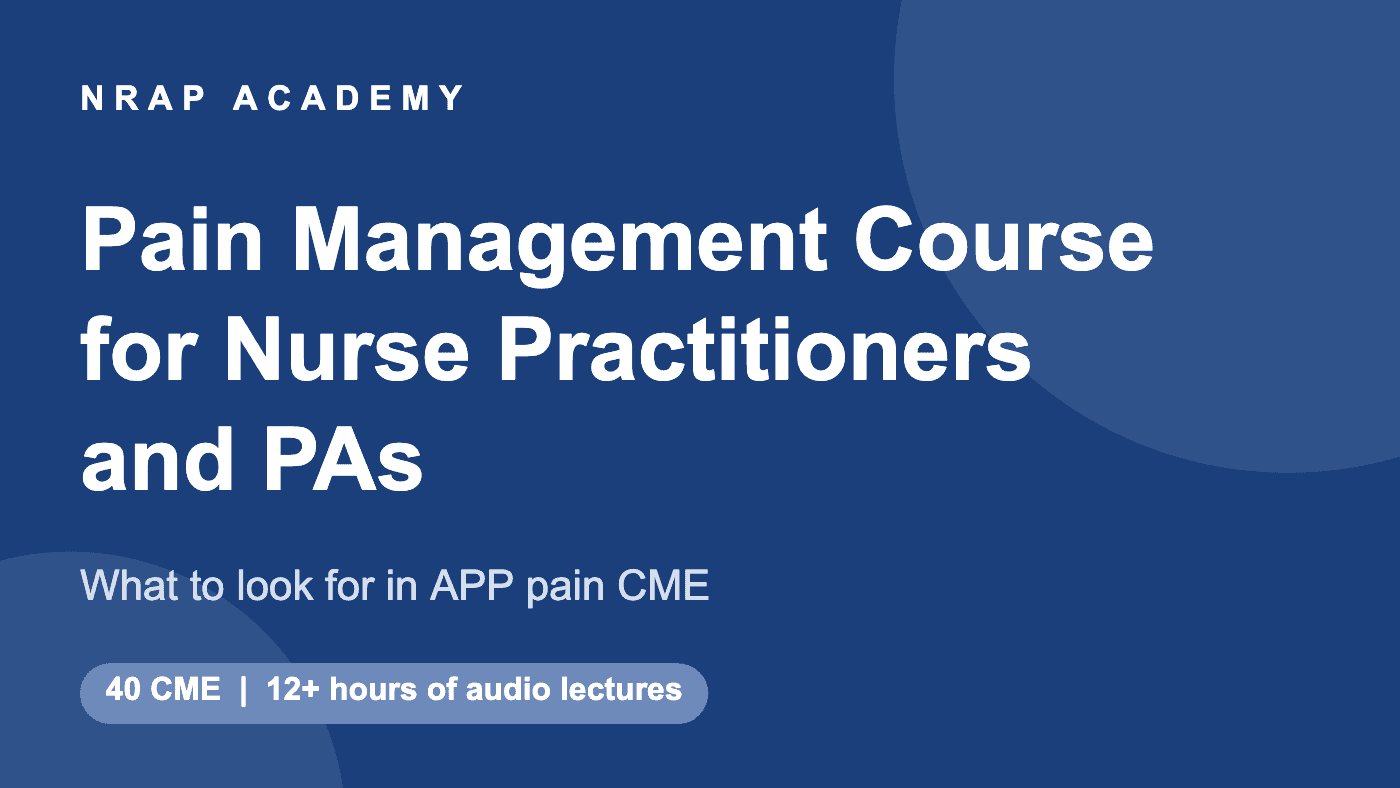
NRAP Academy's Pain for the Advanced Practice Providers course is a pain management course for nurse practitioners, physician assistants, and other APPs. It includes more than 70 lessons, over 12 hours of audio lectures, video lessons, and practice quizzes, and it offers 40 CME. It is taught by David Rosenblum, MD, an interventional pain physician, and it draws on the PainExam program, which has trained more than 3,500 clinicians since 2008.
A note on credit: the course offers CME. Nursing CE credit is not yet available, so nurse practitioners should confirm that CME meets their board's requirements.
See the Course and Free Preview
Add hands-on skills with a live workshop
Online lessons build knowledge, and hands-on practice builds confidence. APPs are welcome at NRAP Academy's live workshops, and the Ultrasound-Guided IV Access and Joint Injection workshops are the most popular with advanced practice providers. Check the schedule to find a date near you.
View the Course CalendarUltrasound TrainingNRAP Academy for Nurses
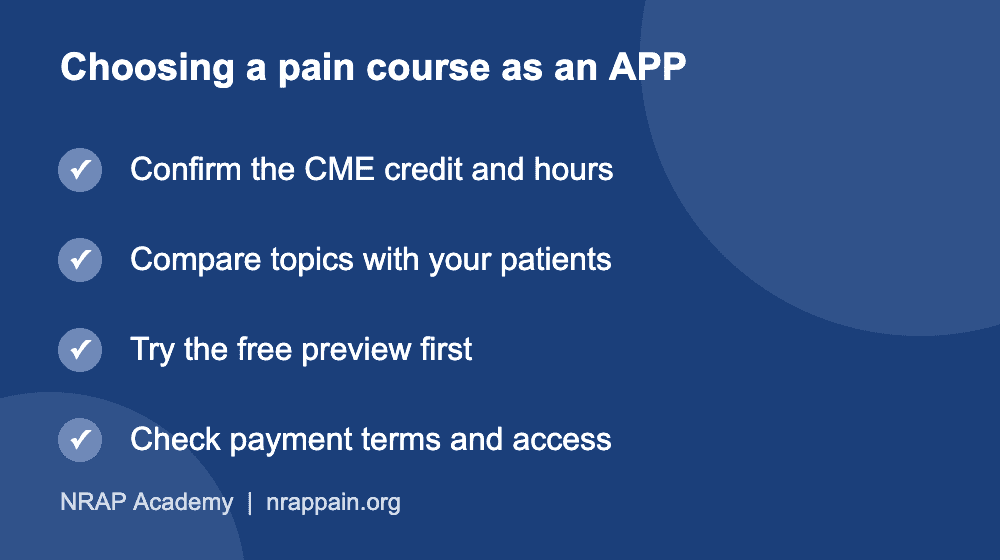
How to choose a pain management course for nurse practitioners: a quick checklist
- Confirm the credit type and number of hours.
- Compare the topics with the patients you actually see.
- Try the free preview lessons before you pay.
- Check the payment terms and how long you keep access.
FAQs
What is the best pain management course for nurse practitioners?
The best choice depends on your practice, but look for clear CME credit, broad clinical coverage, flexible on-demand lessons, and experienced instructors.
Can PAs earn CME with an online pain management course?
Many online pain courses offer CME hours. Check the credit type and hours listed before you enroll, and confirm that they meet your board's requirements.
Do I need hands-on training to treat pain as an APP?
Not for every role, but hands-on workshops help APPs who perform procedures such as ultrasound-guided IV placement or joint injections, within their scope of practice and state rules.
Is there a free preview of the NRAP Academy APP course?
Yes. The course page offers free preview lessons so you can sample the teaching before you enroll.
Final thoughts
The right pain management course for nurse practitioners and PAs gives you current evidence, practical topics, and a format you can actually finish. Start with the free preview, compare the topics with the patients you see, and add a live workshop when you are ready for hands-on skills. With the right training, APPs can treat pain more confidently and refer patients to specialists at the right time.
Clinicians who are looking for Pain Management Board Prep or CME training in regional anesthesia, ultrasound-guided interventional pain, regenerative pain medicine, or ultrasound-guided IV placement should go to NRAPPain.org. Shadowing, online, private, and group training are available. Email Info@NRAPpain.org for details.