Ultrasound Guided IV Access Course for Nurses, PAs and Physicians:
Join Our Workshop Today!
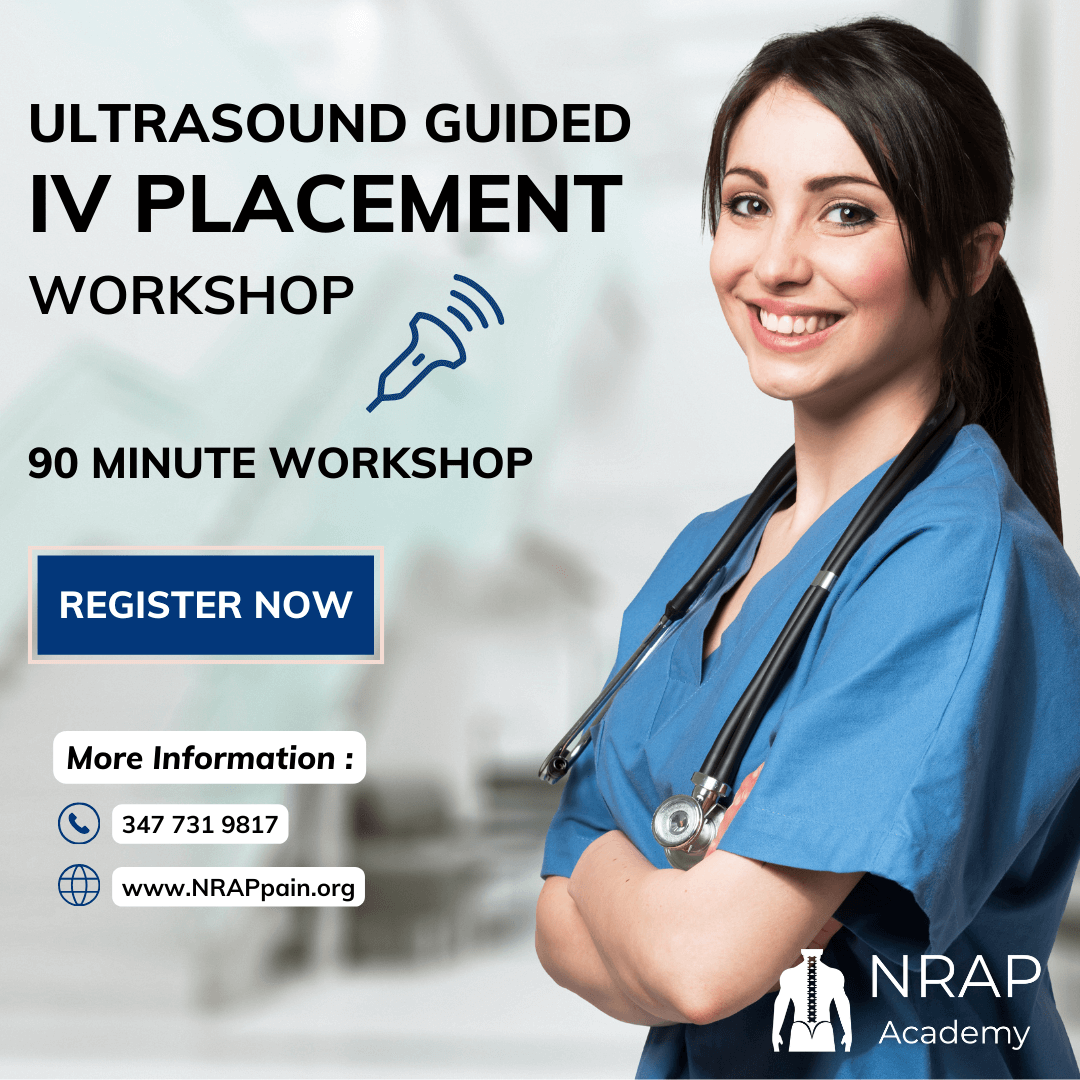
Are you ready to enhance your skills in ultrasound-guided venous access? Look no further! We are thrilled to announce our upcoming Ultrasound IV Access Workshop, brought to you by the NRAP Academy, home of prestigious board reviews and medical education programs.
Ultrasound Guided IV Access Course for Nurses, PAs and Physicians
Event Details:
- Date: Wednesday, May 15, 2024
- Time: 7:30-9PM
- Location: Nomadworks, New York, NY (Venue: 240 W 40th Street, Times Square)
- Pre-Registration Open
- CME Credits: This activity is approved for AMA PRA Category 1 Credit (1.5 CME Credits)
Ultrasound Guided IV Access Course for Nurses, PAs and Physicians
What's Included:
- Comprehensive Ultrasound Guided IV Access Course for Nurses, PAs and Physicians
- Live Scanning Sessions
- Hands-on Practice with Live Models and Phantoms
- Certificate of Completion
Workshop Overview: This 1.5-hour workshop caters to both novice and advanced healthcare providers including nurses, physicians, and physician assistants. Participants will delve into the basic theory and practical aspects of ultrasound-guided venous access. Highlights include:
- Understanding ultrasound principles
- Identifying normal sono-anatomy of the venous system
- Improving IV placement success rate and patient satisfaction
Ultrasound Guided IV Access Course for Nurses, PAs and Physicians
Learning Objectives: By the end of the workshop, attendees will:
- Describe the basic principles of ultrasound
- Identify normal sono-anatomy of the venous system
- Demonstrate needle insertion techniques for ultrasound-guided placement
- Enhance their ability to detect critical structures and improve patient safety
Accreditation: Maimonides Medical Center accredits this course, offering a maximum of 1.5 AMA PRA Category 1 Credits™. Physicians should claim credit commensurate with their participation.

Registration Details:
- Early Bird Registration: $200.00 (30 days prior to the course)Regular Registration: $225.00
- Onsite Registration: $250.00
To register, click here
For cancellation/refund policies and other inquiries, contact click here.
Join Us and Elevate Your Practice by attending our NYC May 15 Ultrasound Guided IV Access Course for Nurses, PAs and Physicians: Don't miss this opportunity to advance your skills in ultrasound-guided venous access. Whether you're a beginner or seeking to refine your expertise, our workshop promises valuable insights and hands-on experience. Secure your spot today and embark on a journey towards excellence in patient care!
Why add Ultrasound to your clinical practice of angio-catheter insertion?
In the realm of modern medicine, advancements in technology continuously reshape clinical practices, often leading to improved patient outcomes and enhanced procedural efficiency. One such advancement that has significantly impacted vascular access procedures is the integration of ultrasound guidance.
Ultrasound should be the standard for inserting central venous catheters (CVCs) and is a create asset for placing difficult intravenous (IV) lines.
Ultrasound offers Enhanced Visualization:
Traditional methods of venous access rely heavily on anatomical landmarks and palpation, which can be imprecise and unreliable, particularly in patients with difficult-to-access veins or complex anatomies. Ultrasound provides real-time visualization of vascular structures, allowing healthcare providers to accurately identify veins and assess their size, depth, and patency. This enhanced visualization minimizes the risk of inadvertent arterial puncture and reduces the number of attempts required for successful cannulation, thereby enhancing patient safety and comfort.
Improved Success Rates: Inserting IVs and CVCs without ultrasound guidance can be challenging, especially in critically ill patients or those with limited vascular access. Studies have consistently demonstrated higher success rates and lower complication rates when ultrasound is utilized for vascular access procedures. By visualizing the vein in real-time and guiding the needle into the target vessel with precision, ultrasound significantly increases the likelihood of successful cannulation on the first attempt, reducing patient discomfort and the need for multiple insertion attempts.
Reduced Complications using ultrasound to place IV lines:
\One of the most compelling reasons to advocate for ultrasound-guided vascular access is its ability to minimize procedural complications. Accidental arterial puncture, hematoma formation, and nerve injury are among the potential risks associated with blind insertion techniques. With ultrasound, healthcare providers can accurately differentiate veins from arteries, decreasing the likelihood of arterial puncture and its associated complications. Additionally, real-time visualization allows providers to avoid puncturing adjacent structures, reducing the risk of nerve damage and other adverse events.
Enhanced Patient Experience:
For patients undergoing vascular access procedures, comfort and satisfaction are paramount. Traditional methods of venous cannulation can be painful and anxiety-provoking, particularly for individuals with challenging venous anatomy or a history of difficult access. By incorporating ultrasound guidance, healthcare providers can minimize patient discomfort by swiftly and efficiently accessing veins with minimal trauma. This not only improves the overall patient experience but also promotes patient cooperation and compliance with subsequent medical interventions.
Cost-Effectiveness:
While some may argue that the initial investment in ultrasound equipment and training represents a financial barrier to widespread adoption, numerous studies have demonstrated the cost-effectiveness of ultrasound-guided vascular access. By reducing the incidence of complications, failed insertion attempts, and the need for additional procedures, ultrasound ultimately leads to significant cost savings for healthcare institutions. Moreover, the potential for improved patient outcomes and reduced length of hospital stays further underscores the economic benefits of implementing ultrasound-guided techniques.
Other Courses available for Nurses, PAs and APPs:
- Peer Reviewed

- Evidence Based
- Interventional and Non Interventional Pain CME
- On Demand and Live Workshops
- For Nurses, PAs, Physicians and more!
Disclaimer: This CE activity is for continuing education purposes only. Attendees consenting to have their images used for educational or marketing purposes should notify Dr. Rosenblum in writing prior to the course. For disability accommodations, please contact [Contact Information] at least 4 weeks before the event.
For more information and updates, visit [Website]. We look forward to welcoming you to our workshop!