Deep Cervical Plexus Block and Cervical Radiculopathy
This PainExam Podcast episode reviews a patient with upper cervical radiculopathy at C3,4 and Dr. Rosenblum ponders whether a deep cervical plexus block would be enough. Here the rational is to do a selective nerve root block with ultrasound at C3 and C4 which would block
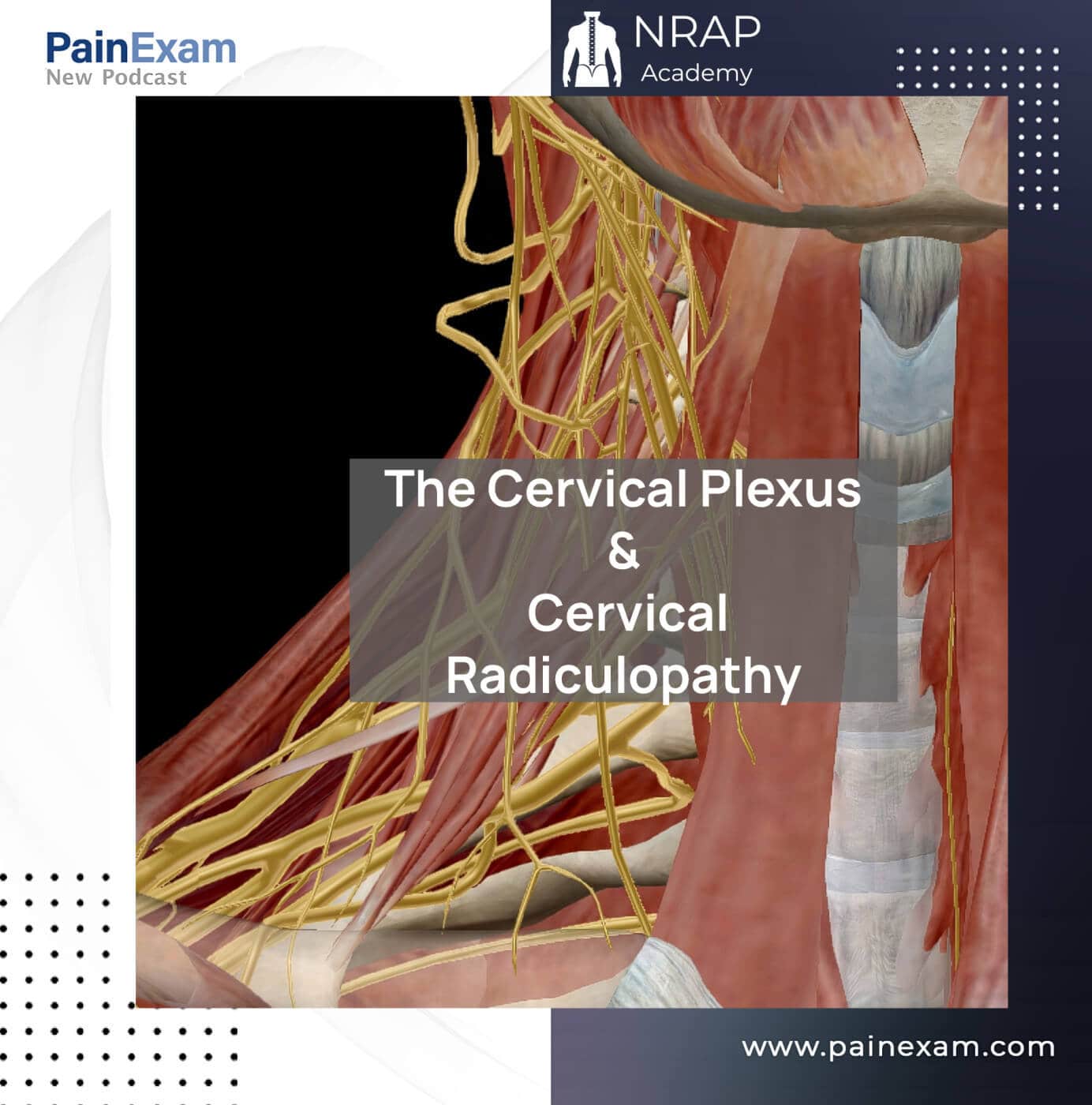
The cervical plexus is a complex network of nerves located in the neck region, originating from the anterior rami (branches) of the cervical spinal nerves, specifically those stemming from the upper cervical segments (C1 to C4). This intricate network serves to provide sensory and motor innervation to various structures within the neck and surrounding areas.
Why perform the block as a deep cervical plexus block as opposed to a cervical epidural or selective nerve root block?
- interlaminar approach (typically near C6/7 or C7/T1), while safer than C3/4, may be too distal (larger volume to reach higher level means more saline and diluted steroid
- Selective or transformainal flouroscopic approach may have a higher vascular risk and be more painful as one cannot visualize the exiting nerve roots under flouorscopy
- Ultrasound approach can identify C3,4 and other nerves of the cervical plexus, as well as blood vessels. Blocking the deep cervical plexus at the roots will ineffect anesthetize the C3 and 4 nerve roots (so you perform the root block and plexus block together), it will also remove need for xray. Unfortunately many payors will not reimburse the T code which used for an ultrasound guides selective/transforaminal injection
- A deep cervical plexus block can be performed with ultrasound alone, target the exiting nerve root, and may be reimbursed if performed accurately and apropraitely coded (discuss this with your coders or billing company first)
Regional Anesthesia & Pain Ultrasound Course
Private Coaching Available
Email Info@NRAPpain.org
 Anatomy
The cervical plexus is positioned within a groove between the longus capitis and the middle scalene muscles in the neck. It is organized into different nerve loops and branches that radiate outwards to supply various regions. The cervical plexus can be divided into deep and superficial components, each with distinct functions and innervation patterns.
Cervical Plexus
The cervical plexus involves nerve loops and branches that provide both sensory and motor functions. The superficial sensory branches originating from adjacent anterior spinal nerves (C2 to C4) are responsible for providing sensation to specific areas of the skin, particularly in the head, neck, and shoulder regions. These sensory branches include the lesser occipital nerve (C2, C3), great auricular nerve (C2, C3), transverse cervical nerve (C2, C3), and supraclavicular nerves (C3, C4). These nerves typically run posteriorly and then penetrate the prevertebral fascia before reaching the skin and superficial structures.
The plexus involves the formation of a nerve loop called the ansa cervicalis. The ansa cervicalis is formed by the fibers emanating from the superior (C1–C2) and inferior (C2–C3) roots of the cervical plexus, which unite at the level of the omohyoid muscle's central tendon. The ansa cervicalis supplies motor branches to certain muscles in the neck region, including the infrahyoid muscles and the sternocleidomastoid muscle.
The cervical plexus is integral in various functions, such as providing sensory feedback, controlling muscle movements, and participating in the autonomic nervous system's regulation. It also participates in numerous anatomical anastomoses, connecting with other important nerves such as the spinal accessory nerve, hypoglossal nerve, facial nerve, vagus nerve, glossopharyngeal nerve, and the sympathetic trunk.
Cervical plexus block
Deep Cervical Plexus Block: An Overview
Patient Positioning: Supine with head turned.
Ultrasound Probe Placement: Position a high-frequency ultrasound probe over the posterior triangle of the neck to visualize the deep cervical plexus, sternocleidomastoid muscle, and other relevant structures.
Needle Insertion: Using real-time ultrasound guidance, insert the needle in-plane or out-of-plane, visualizing its trajectory on the ultrasound monitor.
Local Anesthetic Injection: Administer the local anesthetic while observing its spread in real-time under ultrasound guidance. Consider non particulate steroid for chronic pain or to prolong effect of local anesthetic.
Confirmation: Verify the appropriate distribution of the anesthetic around the deep cervical plexus using ultrasound imaging.
Ultrasound technique Advantages:
Real-time visualization enhances accuracy and reduces the risk of complications.
Suitable for patients with anatomical variations or challenging landmarks.
Limitations:
Requires ultrasound equipment and expertise.
Increased procedural time due to setup and ultrasound scanning.
 For more information, and to Register
Click Here!
Dr. David Rosenblum: Pioneering Pain Management Education
Dr. David Rosenblum, MD, is a significant figure in the Pain Management landscape, particularly renowned for his contributions to education and training. As the Director of Pain Management at Maimonides Medical Center, Dr.

Rosenblum's impact extends to the creation of educational platforms like PainExam.com, AnesthesiaExam.com, PMRExam.com, NRAP Academy, and International Pain Academy. He's instrumental in disseminating knowledge related to regional anesthesia and interventional pain management through live courses. Dr. Rosenblum's expertise has led him to conduct courses not only in New York but also around the world.
For up to date Calendar, Click Here

An integral part of his work involves integrating ultrasound guidance into pain procedures to enhance safety and precision. He's been recognized as one of the earliest physicians to champion the use of ultrasound in interventional pain procedures. Dr. Rosenblum's commitment to pain education is further evident in his role as a managing partner at AABP Integrative Pain Care, a multi-physician private pain practice in Brooklyn and Garden City, NY. He's received accolades including mentions in NY Magazine's Best Pain Management Doctor List and appearances on media outlets like NY1 News and XM Radio's Doctor Talk.

For an appointment call 718 436 7246 or 516 482 7246
Additionally, Dr. Rosenblum actively collaborates with renowned societies such as the American Society of Pain Nad Neuroscience (ASPN), American Society of Interventional Pain Physicians (ASIPP), the Eastern Pain Association (EPA), and the North American Neuromodulation Society (NANS). He's played an instrumental role in helping over 3000 physicians pass the Pain Management Boards. Through his podcasts like PainExam, AnesthesiaExam, and PMRExam, he strives to promote the safe and effective use of ultrasound in various pain procedures.
For those seeking consultations or more information, the avenues are plentiful - from visiting AABPpain.com for a consultation with Dr. Rosenblum. Physicians looking to go to a CME Pain Management Board Review Course or get training in Regenerative Pain Medicine or Ultrasound should visit NRAPpain.org and PainExam.com/events. Dr. Tolba and Dr. Rosenblum's efforts underscore the importance of collaboration, education, and innovation in creating a world with less pain and improved well-being.

Upcoming Courses
Ultrasound Guided Regional Anesthesia and Pain Medicine NYC- August 19th, 2023
Ultrasound Guided Regional Anesthesia and Pain Medicine- Sept 15, 2023, San Juan, PR
For up to date Calendar, Click Here!