Navigating Challenges in Neuromodulation: A Comprehensive Case Study
Suhas Kochat, MD
Chronic pain management has seen remarkable advancements through the decades. Specifically, the development of neuromodulation techniques has truly changed the course of nonopioid pain management. The most utilized neuromodulation modalities include spinal cord stimulators (SCS) and dorsal root ganglion stimulators (DRG-S). These stimulators have shown promise in conditions like complex regional pain syndrome (CRPS), peripheral neuropathies, and failed back syndrome. However, complications, particularly lead fractures and migration, necessitate comprehensive understanding and careful management. Research has shown that SCS lead fracture rates are more rare than lead migration. Thus, the importance of understanding these complications and recognizing symptomatic manifestations are essential for proper evaluation and efficiently treating these patients.
NRAP (Neuromodulation, Regional Anesthesia and Pain) Academy
is proud to offer the Virtual Pain Fellowship which encompasses the PainExam Complete Curriculum plus Bonus content like the On Demand Regenerative Pain medicine Course.
Click here for Board Review
Click here for the Virtual Pain Fellowship
Navigating Challenges in Neuromodulation: A case study
This brings us to an interesting case study involving DRG-S implantation in a 56-year-old female with nine year history of CRPS II, manifesting after multiple surgeries to her left foot after initial mechanical injury. On the physical exam, she presented with erythematous skin overlying the region, hyperalgesia in the tibial nerve distribution, and reduced range of motion. The patient proceeded to trial a DRG-S secondary to fail therapies and multimodal analgesic alternatives.
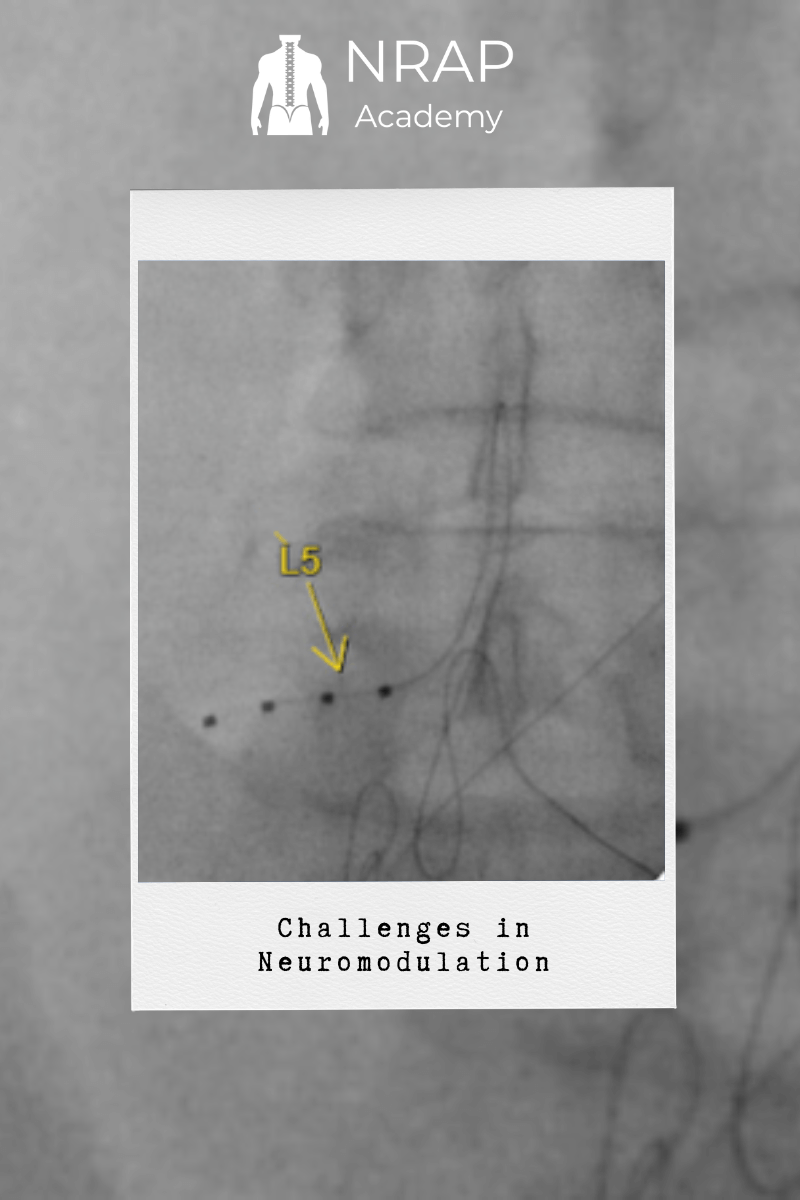
After successfully completing a comprehensive multidisciplinary assessment, a left L5, S1 DRG-S trial was placed under fluoroscopic guidance. Abbott leads were placed in the left L5 dorsal root ganglia and S1 interforaminal region with one lead contact protruding past the interforaminal line. The patient reported good paresthesia coverage over the affected area and permanent implant of a DRG-S at L5 and S1 was placed.
On subsequent post procedure follow ups, after initial improvement in back pain a month, she noted a sudden increase in her back pain. Her stimulator continued to provide excellent leg pain relief but now was causing significant back pain. Subsequent x-ray was unremarkable, and leads were unchanged from initial placement. A trial of Robaxin and meloxicam did not offer any benefit.
With continued pain in subsequent months near the IPG site, she proceeded to have IPG pocket revision. During revision, fluoroscopy incidentally found the L5 lead had migrated away from the foraminal canal and demonstrated a slight kink in the lead as well. As the L5 lead was withdrawn, tension was experienced against the soft tissue from the prior surgical looping. Upon pulling the lead end on end, the lead snapped and was partially retained in the soft tissue. Upon evidence that the L5 lead had fractured, fluoroscopy was used to identify fragments and map out tissue dissection. The retained component was then removed. A new lead was able to be placed without incident. Upon final follow up, the patient reports excellent pain control in her foot and lower back.
When analyzing lead fracture damage complications, they most often occur when tension damages the lead’s insulation coat. In fact, damage to the lead and inner insulation over time may lead to transient stimulation of unwanted regions within the pain pathway. In addition, most fractures in case studies were seen to be due to bending/kinking that occurred distal to the deeper fascia fixation point, especially with the utilization in lead stabilization with surgical looping. Separate case reports have found that the locations outside of the epidural space where the S-loops are located also increase the risk of lead fracture.
DRG-S has proved to be an effective therapeutic alternative for many that suffer from CPRS. As chronic pain physicians begin to implement more neuromodulation in their practice, it is important to inform patients of the long-term risk with the integrity of the leads and possible changes in their pain relief. These aspects, which cannot be completely avoided, lead to the importance of awareness of areas to implement checkpoints during surgical placement.
Figure 1a Intraoperative fluoroscopy image of L5 lead
1b Intraoperative fluoroscopy image of L5 lead during revision
Upcoming Workshops and Events
|
Saturday, October 28, 2023 8:00 AM |
||
|
Charleston, SC Regional Anesthesia and Pain Ultrasound CME Workshop |
Sunday, October 29, 2023 9:00 AM |
|
|
Saturday, November 11, 2023 8:00 AM |
||
|
Saturday, December 16, 2023 7:30 AM |
||
|
Saturday, January 6, 2024 7:30 AM |
For up to date Calendar, Click Here!
Reference
- Zyluk A, Puchalski P. Complex regional pain syndrome of the upper limb: a review. Neurol Neurochir Pol 2014;48:200–5.
- Cameron T. Safety and efficacy of spinal cord stimulation for the treatment of chronic pain: a 20-year literature review. J Neurosurg. 2004; 100:254–67.
- Chapman KB, Mogilner AY, Yang AH, Yadav A, Patel KV, Lubenow T, van Helmond N, Deer T, Kallewaard JW. Lead migration and fracture rate in dorsal root ganglion stimulation using anchoring and non-anchoring techniques: A multicenter pooled data analysis. Pain Pract. 2021 Nov;21(8):859-870.
- Simvanesan E, Bicket MC, Cohen SP. Retrospective analysis of complications associated with dorsal root ganglion stimulation for pain relief in the FDA MAUDE database. Reg Anesth Pain Med 2019;44:100–6.
- Kim TH, Lee PB, Son HM, Choi JB, Moon JY. Spontaneous lead breakage in implanted spinal cord stimulation systems. Korean J Pain. 2010;23(1):78-81.
- Eldabe S, Buchser E, Duarte R. Complications of Spinal Cord Stimulation and Peripheral Nerve Stimulation Techniques: A Review of the Literature, Pain Medicine, Volume 17, Issue 2, February 2016, 325–336.
- Chauhan G, Roth BI, Mekhail N. Dorsal root ganglion stimulation lead fractures: potential mechanisms and ways to avoid. BMJ Case Reports CP 2021;14:e241353.
- Chapman KB, Patel KV, van Helmond N, et. al. Dorsal Root Ganglion Stimulation Lead Fracture Within the Superficial Fascial Layers in 4 Cases, A & A Practice: September 2020 - Volume 14 - Issue 11 - p e01307.
- Bedder, MD and Bedder, HF. Spinal Cord Stimulation Surgical Technique for the Nonsurgically Trained. Neuromodulation: Technology at the Neural Interface. 2009; 12: 1-19.
- Kent AR, Min X, Hogan QH, et al. Mechanisms of dorsal root ganglion stimulation in pain suppression: a computational modeling analysis. Neuromodulation 2018;21:234–46.
- Henderson JM, Schade CM, Sasaki J, et al. Prevention of mechanical failures in implanted spinal cord stimulation systems. Neuromodulation 2006;9:183–91.
- Kumar K, Taylor RS, Jacques L, et al. The effects of spinal cord stimulation in neuropathic pain are sustained: A 24-month follow-up of the prospective randomized controlled multicenter trial of the effectiveness of spinal cord stimulation. Neurosurgery 2008; 63:762–70.
Suhas Kochat, MD, MBA spent the majority of his life in Texas and is a proud alumni of the University of Texas at Austin, receiving BS in Biology and minor in Business. He received his medical and business degree from the University of Texas and University of Houston, respectively. He then completed four years of Anesthesia training from Duke University Medical Center and currently has transitioned to internal medicine residency at Novant Health in North Carolina. He has participated in national pain conferences involving pain education and has published in pain journals in regards to neuromodulation case reports and the influence of telemedicine in pain management. He will be continuing to a chronic pain fellowship in 2025.