Intra-articular & PENG Phenol Neurolysis for Hip Pain
Podcast Show Notes: Phenol in the Treatment of Hip Pain
Welcome to PainExam Podcast, where medical experts share insights on innovative approaches to pain management. In this episode, Intra-articular & PENG Phenol Neurolysis for Hip Pain on the PainExam Podcast Host, David Rosenblum, MD delves into the use of phenol as a therapeutic option for hip pain. Stay tuned for valuable information on phenol injections into the pericapsular nerve group, the hip joint, and the outcomes observed through isolated case reports.
[Bonus CME Opportunity] Earn Continuing Medical Education (CME) credits by reflecting on this podcast. Visit CMEfy to explore the opportunity (Processing Fee: $15).
Key Discussion Points on Intra-articular & PENG Phenol Neurolysis for Hip Pain Podcast:
- Dr. Rosenblum explores the mechanism of action of phenol and its application in treating hip pain.
- Isolated case reports shed light on the outcomes of phenol injections into the pericapsular nerve group.
- A refractory case of neuralgia paresthetica is discussed, emphasizing the challenges and potential solutions.
Wider Pain Management Topics:
- Insights into hip cancer-related pain and the role of Intra-articular & PENG Phenol Neurolysis for Hip Pain in addressing it.
- Discussion on pain stemming from deep vein thrombosis (DVT) and the application of IPACK or articular branch of the tibial nerve block for posterior capsule knee pain in the outpatient chronic pain setting.
Dr. Rosenblum's Updates:
- If you enjoined this podcast on Intra-articular & PENG Phenol Neurolysis for Hip Pain, discover Dr. Rosenblum's ultrasound training programs.
- Learn about the migration of the PainExam platform to the new NRAPpain.org website.
- Check out the all-new PainExam Board Prep and CME Refresher Course at NRAPpain.org, offering comprehensive resources for medical professionals.

- For a free Radiology Cheat sheet, Click here
To learn Ultrasound for the implemtnation of Intra-articular & PENG Phenol Neurolysis for Hip Pain, check out our Course Calendar
Radiology Cheat Sheet Summary: Imaging Pearls and Disc Herniations
This cheat sheet provides valuable insights into imaging techniques and disc herniations, offering key information for medical professionals. Here's a summary of the essential points:
Modic Types:
- Modic Type 1: Low signal on T1WI, high on T2WI, indicating fibrovascular tissue, inflammatory changes, and possible edema. Correlated with low back pain.
- Modic Type 2: High signal on T1WI, isointense or high on T2WI, representing bone marrow replacement by fat.
- Modic Type 3: Low signal on T1WI, low on T2WI, indicative of reactive osteosclerosis.
Schmorl's Nodes:
- Protrusions of disc material into the vertebral body surface, associated with inflammation and vertebral bone necrosis.
Protrusion, Extrusion & Sequestration:
- Protrusion: Disc herniation with a smaller distance between edges than at the base.
- Extrusion: Disc material edges farther apart than at the base.
- Sequestration: Displaced disc material loses continuity with the parent disc.
Imaging Techniques:
- STIR Sequence: Suppresses fat signal, enhancing signal from tissues with long T1 and T2 relaxation times, useful for neoplastic and inflammatory tissues.
- Bone Scan: Reveals increased uptake at infection sites; more sensitive but less specific than plain film and CT.
- PET and PET/CT: High sensitivity in detecting spondylodiscitis; negative scan virtually excludes infectious spondylodiscitis.
Disc Herniation Patterns:
- Central Herniations: Often slightly left or right due to thickness of posterior longitudinal ligament (PLL).
- Subarticular Herniations: Common due to thinner PLL.
- Foraminal Herniations: Rare, but can cause severe pain, sciatica, and nerve cell damage.
- Extraforaminal Herniations: Uncommon, may involve High Intensity Zone (HIZ) indicating healing or breakdown products.
Important Notes:
- Discount Offer: Get 20% OFF with code PAINEDU at checkout.
- CT Imaging: Preferred for bone and abnormal calcification.
- Ultrasound and Regenerative Pain Medicine Training: Explore courses at NRAPpain.org.
This cheat sheet serves as a quick reference for radiology professionals and offers a comprehensive overview of imaging pearls and disc herniation nuances. For more in-depth knowledge, refer to the detailed content in the original cheat sheet.Disclaimer:
Intra-articular & PENG Phenol Neurolysis for Hip Pain is not a benign procedure and may have risks associated with it. The most concerning is motor weakness and phenol toxicity.
This Podcast, website and any content from NRAP Academy (PainExam.com) otherwise known as Qbazaar.com, LLC is for general informational purposes only and does not constitute the practice of medicine, nursing or other professional health care services, including the giving of medical advice, and no doctor/patient relationship is formed. The use of information on this podcast or materials linked from this podcast is at the user’s own risk. Professionals should conduct their own fact finding, research, and due diligence to come to their own conclusions for treating patients. The content of this podcast is not intended to be a substitute for professional medical advice, diagnosis, or treatment. Users should not disregard or delay in obtaining medical advice for any medical condition they may have and should seek the assistance of their health care professionals for any such conditions.
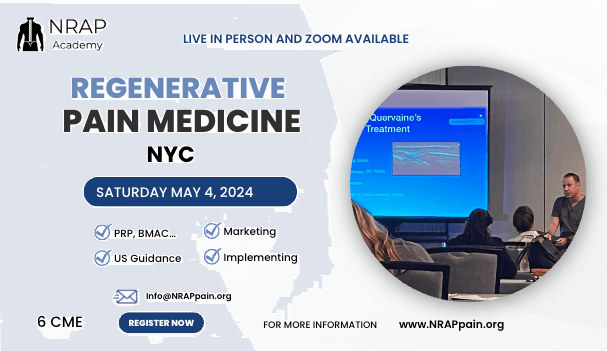
Join us on May 4, 2024 for our Upcoming Regenerative Pain Medicine Course in NYC
This workshop is tailor-made for Pain Physicians, Regional Anesthesiologists, CRNAs, APPs, PM&R, PAs, Physicians, and any Clinician involved in interventional pain or with an interest in regenerative medicine procedures. Whether you're a beginner or an experienced practitioner, this event promises valuable insights and skill enhancement.
Learning Objectives: By participating in this activity, attendees will:
- Understand Regenerative Medicine: Gain a solid understanding of the basic principles and applications of regenerative medicine.
- Master Ultrasound Techniques: Identify normal sono-anatomy of common targets, honing skills crucial for precision in procedures.
- Navigate Biologics: Describe various biologics and comprehend the processing involved, enhancing your proficiency in regenerative medicine applications.
Don't miss this opportunity to stay at the forefront of regenerative medicine in pain management! Join us at the NRAP Regenerative Pain Medicine Workshop and revolutionize your approach to chronic pain treatment. Secure your spot now for a day of education, hands-on experience, and networking with experts in the field. Visit NRAPPain.org for registration and details.
Patient Consultation:
 David Rosenblum, MD has been treating pain since 2007. Named as NY Magazine's Top Pain Physician on a year after year basis, he completed his training at NYU Lagone Medical Center and now serves as the Director of Pain Management at AABP Pain Care and Wellness and Maimonides Medical Center.
- Patients interested in scheduling a consultation with Dr. Rosenblum can call 516 482 7246 or 718 436 7246.
Additional Resources and References:
- [Monagle, John; Ee, Joanne. Treatment of chronic hip osteoarthritic pain with intra-articular phenol. Indian Journal of Pain, 27(1), Jan–Apr 2013. DOI: 10.4103/0970-5333.114866](insert link)
- [Marcio V. Pimenta et al. Ultrasound-guided pericapsular nerve group and obturator nerve phenol neurolysis for refractory inpatient hip cancer metastasis pain: a case report, Brazilian Journal of Anesthesiology (English Edition), 2021](insert link)
- [Rocha Romero, A., Carvajal Valdy, G. & Lemus, A.J. Ultrasound-guided pericapsular nerve group (PENG) hip joint phenol neurolysis for palliative pain. Can J Anesth/J Can Anesth 66, 1270–1271 (2019). DOI: 10.1007/s12630-019-01448-y](insert link)
For more details on upcoming live courses, check out our [Live Course Calendar](insert link).
Thank you for joining us on [Podcast Name]. Stay informed, stay empowered.