Intradiscal PRP Injections
David Rosenblum, MD, Brooklyn and Long Island Based Interventional Pain Physician discusses his treatment of Degenerative Disc Disease using Intradiscal PRP Injections on his Internationally recognized pain management podcast the PainExam Podcast.
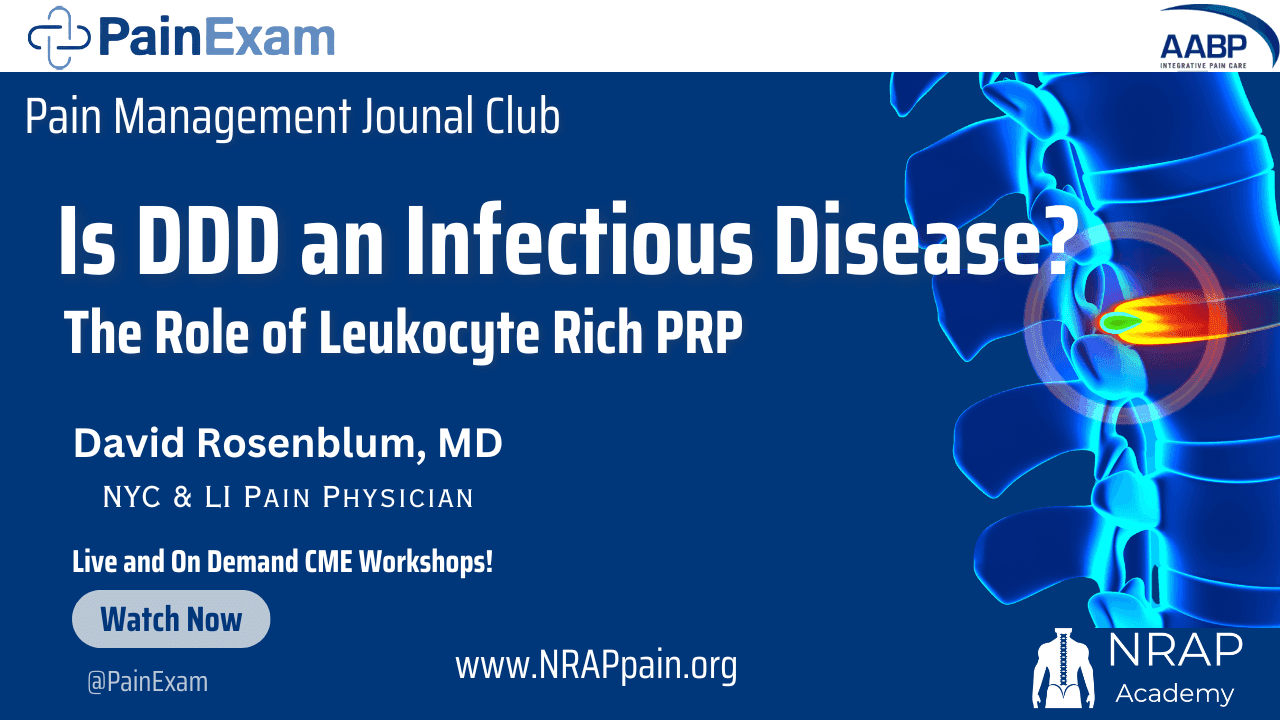
Dr. Rosenblum reviews Dr. Gregory Lutz's article describing the underlying causes of Degenerative Disc Disease (DDD) and explores the role of bacteria, particularly Cutibacterium Acnes (C. Acnes), in its development. It highlights that chronic low back pain often stems from unhealed wounds inside the disc, which can become infected with bacteria like C. Acnes, hindering the healing process. The article suggests that traditional medical and surgical treatments for DDD often fail to address these root causes.

Patients interested in scheduling a consultation can call 718 436 7246 or 516 482 7246 or go to www.AABPpain.com
Research indicates that the microbiome, the ecosystem of microorganisms in the body, may play a significant role in DDD. Studies have shown a correlation between the presence of bacteria, particularly C. Acnes, and degenerative disc disease. However, treating chronic low back pain with oral antibiotics raises concerns about efficacy, antimicrobial resistance, and adverse effects on the gut microbiome.
Regenerative medicine, particularly the use of
Platelet-Rich Plasma (PRP), is proposed as a potential solution for DDD. PRP contains healing growth factors and white blood cells that can stimulate the wound healing process and suppress harmful bacteria. Pre-clinical studies have demonstrated the beneficial effects of PRP on disc cell metabolism, proliferation, and inflammation reduction.
Clinical studies have shown promising results in treating chronic low back pain with intradiscal PRP injections. Patients experienced significant pain relief and functional improvement, with a reduced need for spinal fusion surgery. MRIs of treated patients showed improvement or disappearance of disc tears, indicating the effectiveness of PRP in promoting disc healing and reducing the need for invasive procedures like spinal fusion.
Overall, the article suggests that addressing the root causes of DDD, such as bacterial infection and impaired wound healing, through regenerative medicine approaches like PRP injections, could offer a sustainable solution for this debilitating condition.
This article on Intradiscal PRP Injections also aimed to find ways to minimize risks associated with a promising new procedure, ensuring that its potential benefits far outweigh any potential drawbacks. Previous research and our own observations indicated that Cutibacterium Acnes (C. Acnes) was often responsible for infections related to intradiscal biologic procedures. To investigate further, they conducted lab experiments culturing C. Acnes bacteria with different types of Platelet-Rich Plasma (PRP) - comparing those with higher levels of white blood cells (leukocyte rich, LR-PRP) to those with lower levels (leukocyte poor, LP-PRP). The author's findings showed that LR-PRP exhibited superior bacteria-killing capabilities, suggesting it might not only be the most effective type of PRP for degenerative disc disease but also potentially the safest. Their extensive clinical experience supports this, as THey haven't encountered any infections in over 1000 disc injection procedures using LR-PRP.
Furthermore, the author speculates that Intradiscal PRP Injections with L-PRP might serve a dual purpose. Not only does it trigger the body's natural healing response in the disc, but the elevated levels of white blood cells in LR-PRP may also suppress the overgrowth of bacteria associated with disc degeneration.
For instance, consider the case of a 32-year-old woman with severe lower back pain (LBP) that hadn't responded to traditional treatments. Despite no specific triggering event, her pain was debilitating, affecting her ability to care for her child. MRI scans revealed significant degenerative disc changes. Having exhausted other treatment options, she opted for intradiscal LR-PRP after weighing its pros and cons.
Collaborating with an industry partner, the author developed a new PRP system capable of concentrating platelets and white blood cells to higher levels than existing commercial systems. In her case, each disc received injections of over 5 billion platelets and 100 million white blood cells, delivering a potent mix of healing proteins and antibacterial agents precisely where needed. Initial discomfort subsided within weeks, and subsequent MRI scans three months later showed remarkable improvement, with the majority of her pain gone along with the observed disc changes.
The author's experiecne experience with similar cases leads us to believe that Intradiscal PRP Injections with L-PRP might offer a comprehensive solution for treating degenerative disc disease, addressing both its symptoms and underlying causes. Now, with what they consider the safest and most effective intradiscal biologic identified, they're exploring avenues to further enhance patient outcomes.

Regenerative Medicine and Ultrasound Pain Medicine Workshop Ov

erview
Day 1: Regenerative Medicine Workshop
- Topics: Platelet Rich Plasma, Bone Marrow Aspirate, Lipo-aspirate derived stem cells, Amniotic FluidProducts, Ultrasound Targeting, Legal and regulatory issues.
- Schedule: 4 hours of lectures, 2 hours of demonstrations.
Day 2: Ultrasound Guided Acute and Chronic Pain Medicine Workshop
- Topics:
- Upper Extremity Blocks: Suprascapular, Axillary, Median, Ulnar, Radial Nerve Blocks.
- Lower Extremity Blocks: Lateral Femoral Cutaneous, Femoral, Saphenous, Genicular, Sciatic, Sural, Tibial, Superficial Peroneal Nerve Blocks.

- Peripheral Nerve Blocks: Intercostal, Ilio-inguinal, Paravertebral, TAP Block.
- Soft Tissue and Joint Injections: Shoulder, Hip, Knee Joint Injections, Tendons.
- Spine & Sympathetic Blocks: Facet, Medial Branch, Caudal Epidural, Stellate Ganglion, Sacroiliac Joint Injections.
- Schedule: 4 hours of lectures, 2 hours of live ultrasound scanning on models.
Activity Description
- Target Audience: Pain physicians, anesthesiologists, CRNAs, APPs, PM&R specialists, PAs, and other clinicians interested in interventional pain and regenerative medicine.
- Learning Objectives: Understanding regenerative medicine principles, identifying sono-anatomy, and processing biologics.
Accreditation and Logistics
- Credits: Up to 6 AMA PRA Category 1 Credits™.
- Location: NOMADWORKS Times Square.
- Registration: Via www.NRAPpain.org or www.PainExam.com.
- Cancellation Policy: 50% refund if canceled more than 60 days prior; no refund within 60 days.
Additional Information
- Disclosure: Dr. David Rosenblum has no financial disclosures.
- Contact: For disability accommodations, contact Dr. Rosenblum at DRosenblum@Qbazaar.com or 347-731-9817.

References
Lutz, Gregory E. "Intradiscal Leukocyte Rich Platelet Rich Plasma for Degenerative Disc Disease." Physical Medicine and Rehabilitation Clinics of North America 34.1 (2023): 117-133.https://www.binasss.sa.cr/bibliotecas/bhm/feb23/61.pdf