
Table of Contents
- Transversus Abdominis Plane Block Anatomy and Dermatomal Coverage
- Ultrasound-Guided TAP Block Approaches: Subcostal, Lateral, and Posterior
- Step-by-Step Ultrasound-Guided TAP Block Technique
- TAP Block for Acute Postoperative Pain: What the Evidence Shows
- TAP Block for Chronic Abdominal Wall Pain
- TAP Block vs. Targeted Nerve Blocks: When to Choose Which
- Keep Learning
- NRAP Academy Courses
- Looking for a Pain Specialist?
- FAQs
The transversus abdominis plane block, almost always shortened to the TAP block, has become one of the most widely used regional anesthesia techniques for abdominal wall analgesia – and one of the more board-relevant and clinically versatile blocks a pain physician or anesthesiologist will perform, because it covers both acute postoperative pain and a growing role in chronic abdominal wall pain. This guide covers the anatomy, the three ultrasound-guided approaches, step-by-step technique, and the evidence behind using a TAP block for acute and chronic pain alike.
In this post:
- Transversus Abdominis Plane Block Anatomy and Dermatomal Coverage
- Ultrasound-Guided TAP Block Approaches: Subcostal, Lateral, and Posterior
- Step-by-Step Ultrasound-Guided TAP Block Technique
- TAP Block for Acute Postoperative Pain: What the Evidence Shows
- TAP Block for Chronic Abdominal Wall Pain
- TAP Block vs. Targeted Nerve Blocks: When to Choose Which
- Keep Learning
- NRAP Academy Courses
- Looking for a Pain Specialist?
Transversus Abdominis Plane Block Anatomy and Dermatomal Coverage
The transversus abdominis plane (TAP) is the neurovascular fascial plane between the internal oblique and transversus abdominis muscles – the same plane an ilioinguinal/iliohypogastric nerve block targets near the iliac crest, except a TAP block is performed more centrally and is designed to catch the thoracolumbar nerves broadly rather than two specific nerves. The anterior rami of T6 through L1 – the lower thoracic intercostal nerves, the subcostal (T12) nerve, and the iliohypogastric and ilioinguinal nerves – all travel through this plane before branching to supply the skin and muscles of the anterolateral abdominal wall. A local anesthetic deposited in the TAP therefore anesthetizes the sensory nerves supplying the abdominal wall at and below the level of injection, without providing any visceral analgesia – an important board point, since a TAP block addresses incisional and somatic abdominal wall pain, not deep visceral pain from bowel or peritoneal manipulation.
The original landmark-based ("blind") TAP block described by Rafi in 2001 used the triangle of Petit as its surface landmark – a space bounded by the latissimus dorsi posteriorly, the external oblique anteriorly, and the iliac crest inferiorly – before ultrasound guidance became standard. Clinically, the dermatomal coverage of a TAP block depends heavily on which approach is used and how far cephalad or caudad the injectate spreads, which is the basis for the three-approach framework below.
Ultrasound-Guided TAP Block Approaches: Subcostal, Lateral, and Posterior
Choosing the right transversus abdominis plane block approach is driven by incision location and the dermatomes that need to be covered – a frequently tested distinction, since picking the wrong approach for a given incision is an easy way to under-treat a patient's pain.
| Approach | Probe Position | Dermatomal Coverage | Typical Use Case |
|---|---|---|---|
| Subcostal (oblique) | Parallel to the costal margin, from xiphoid toward the flank | T6–T9 | Upper abdominal/midline incisions (laparotomy, bariatric, upper GI surgery) |
| Lateral / mid-axillary (classic) | Transverse, in the mid-axillary line between costal margin and iliac crest | T10–L1 | Lower abdominal incisions (appendectomy, inguinal hernia repair, cesarean delivery) |
| Posterior | Posterior to the mid-axillary line, near the triangle of Petit | T10–L1, with more extensive spread | Lower abdominal/flank surgery where a longer-lasting, more posteriorly-spreading block is desired |
Many midline laparotomy incisions span both upper and lower dermatomes, which is why a bilateral subcostal TAP block is often combined with a lateral or posterior approach, or why continuous bilateral TAP catheters are used for extended coverage across an entire ERAS (enhanced recovery after surgery) pathway.
Step-by-Step Ultrasound-Guided TAP Block Technique
- Positioning: Patient supine, with the flank on the side being blocked exposed and prepped.
- Transducer selection: A high-frequency (6–13 MHz) linear probe is typically used for the lateral and subcostal approaches given their relatively superficial depth; a curvilinear probe may help in larger patients for the posterior approach.
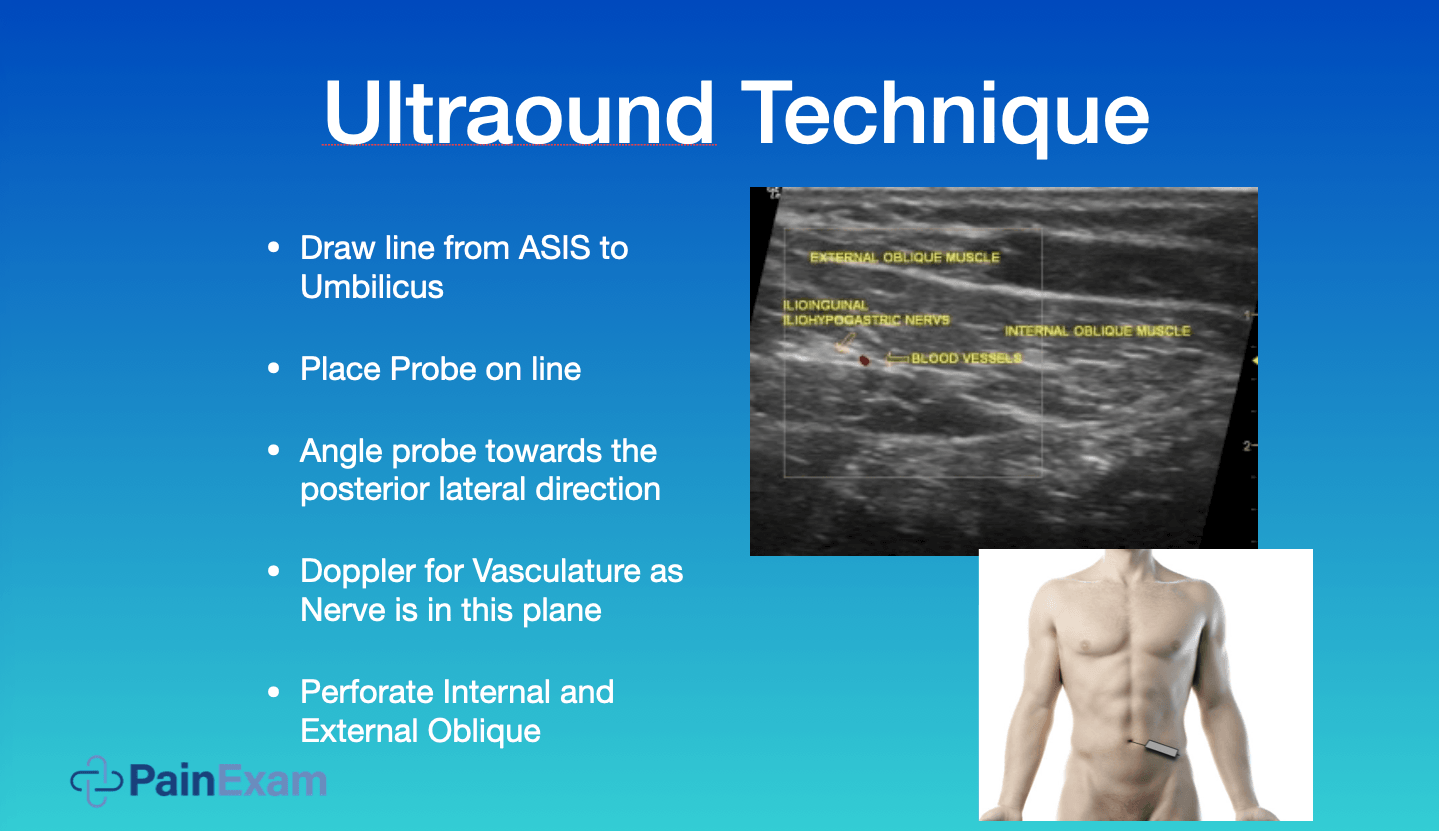
- Scanning: For the classic lateral approach, the probe is placed transversely in the mid-axillary line, midway between the costal margin and iliac crest. Three muscle layers come into view from superficial to deep: external oblique, internal oblique, and transversus abdominis, with the TAP as the fascial plane between the latter two.
- Needle approach: A 21–22-gauge needle is advanced in-plane, typically posterior to anterior, through the external and internal oblique muscles into the TAP.
- Confirmation and injection: After negative aspiration, a small test injection should produce a visible anechoic "splitting" of the internal oblique and transversus abdominis – the hallmark sign of correct plane placement (hydrodissection) – before the remaining volume is injected. Typical volumes are 15–20 mL of local anesthetic per side (commonly 0.25–0.375% bupivacaine or ropivacaine), kept below toxic dose thresholds, especially when blocking bilaterally.
- Catheter placement (optional): For extended analgesia – in an ERAS pathway or for a refractory chronic abdominal wall pain flare – a perineural catheter can be threaded into the TAP for continuous local anesthetic infusion rather than a single injection.
Complications and Safety
Before ultrasound guidance, blind TAP blocks carried a real risk of peritoneal puncture, bowel injury, and intravascular injection, since the triangle of Petit landmark technique could not visualize the needle tip relative to the peritoneum or the branches of the deep circumflex iliac and intercostal vessels that run through the TAP. Direct ultrasound visualization has substantially reduced these risks. Local anesthetic systemic toxicity (LAST) is the complication most worth emphasizing for a transversus abdominis plane block specifically, because the TAP is highly vascular and absorbs local anesthetic quickly – especially relevant when blocking bilaterally or using a continuous catheter, where cumulative dosing must be tracked carefully.
TAP Block for Acute Postoperative Pain: What the Evidence Shows
Acute postoperative analgesia is where the transversus abdominis plane block has the deepest evidence base. A 2023 narrative review in Cureus summarizes TAP block use across abdominal, obstetric, and gynecological surgery, highlighting its role in multimodal, opioid-sparing analgesia and its incorporation into ERAS protocols for procedures ranging from laparoscopic cholecystectomy to colorectal resection.1 The review frames the TAP block's appeal plainly: it is technically straightforward to learn under ultrasound guidance, carries a favorable safety profile compared with neuraxial techniques, and avoids the hypotension and urinary retention risks that can accompany epidural analgesia.
For a clear, quantitative example, a 2018 meta-analysis in the British Journal of Anaesthesia pooled 14 randomized controlled trials (770 women) comparing high-dose versus low-dose TAP block local anesthetic after cesarean delivery.2 Both dosing strategies reduced 24-hour opioid consumption compared with control – the high-dose group by a mean of 22.41 morphine milligram equivalents (MME) and the low-dose group by 16.29 MME – with no significant difference in efficacy between the two doses. The authors concluded that lower-dose TAP blocks provide comparable opioid-sparing analgesia to higher doses, which matters clinically because it lets physicians favor the lower end of the dosing range to reduce local anesthetic toxicity risk without sacrificing effectiveness – a useful, evidence-based answer when patients or trainees ask "how much local anesthetic is actually needed."
TAP Block for Chronic Abdominal Wall Pain
The evidence base for using a transversus abdominis plane block in chronic pain is considerably thinner than for acute postoperative pain, and it is worth being direct about that with patients and trainees alike. A 2023 narrative review in Current Pain and Headache Reports on truncal fascial plane blocks for chronic pain management describes the TAP block literature in this setting as composed mostly of case reports and retrospective observational studies – including steroid TAP injections for chronic abdominal pain, a case series using TAP blocks to both diagnose and treat chronic postsurgical abdominal wall pain, and pediatric reports targeting anterior cutaneous nerve entrapment syndrome (ACNES).3 The review's bottom line: ultrasound-guided truncal plane blocks, including the TAP block, are safe and technically approachable, and can be a valuable part of interdisciplinary chronic pain care, but the supporting evidence remains far less robust than for acute indications.
The best quantitative chronic-pain data currently available comes from a 2024 retrospective study in the Journal of Clinical Medicine, which followed 26 patients with chronic post-hernioplasty pain who received one to four TAP blocks (local anesthetic plus triamcinolone) over 59 total procedures.4 At six months, 20 of 26 patients (77%) were responders with substantial or moderate pain relief, accompanied by improved neuropathic symptom scores and physical quality-of-life measures. Notably, the study also identified predictors of a poor response: non-responders had a longer duration of pain (49.4 vs. 16.8 months), higher BMI, and markedly higher rates of depression (83% vs. 15%), diabetes (50% vs. 0%), and fibromyalgia (67% vs. 0%) than responders. The authors concluded that a TAP block is a reasonable chronic post-hernioplasty pain treatment option, but that medical and psychiatric comorbidities meaningfully reduce its effectiveness – a clinically useful point for setting expectations and for considering a multidisciplinary referral in patients with significant comorbid depression or fibromyalgia before relying on repeated blocks alone.
For patients whose chronic abdominal wall pain is clearly localized to the ilioinguinal and/or iliohypogastric nerve distribution rather than diffusely across the abdominal wall, a more targeted nerve block aimed specifically at those nerves – rather than the broader TAP – is often the more precise next step; see our companion post on ilioinguinal neuralgia treatment and the ultrasound-guided nerve block technique for that approach.
TAP Block vs. Targeted Nerve Blocks: When to Choose Which
| Scenario | Preferred Approach | Why |
|---|---|---|
| Fresh midline laparotomy or multi-quadrant abdominal incision | TAP block (subcostal ± lateral/posterior, often bilateral) | Broad T6–L1 coverage matches a large, multi-dermatome incision |
| Diffuse postoperative abdominal wall pain of unclear nerve distribution | TAP block | Field block covers the full plane without needing to localize a single nerve |
| Focal, reproducible groin/suprapubic pain after hernia repair or Pfannenstiel incision | Targeted ilioinguinal/iliohypogastric nerve block | More precise targeting of the specific entrapped or injured nerve(s) |
| Chronic abdominal wall pain of uncertain source, for diagnostic purposes | Either, chosen based on point tenderness location | A positive response helps localize the pain generator before considering RFA, PRF, or neuromodulation |
Keep Learning
For a broader discussion of abdominal wall pain generators, including the TAP block and the distinction between somatic and visceral abdominal pain, listen to “Abdominal Pain: Somatic Vs Visceral” on The PainExam Podcast, where Dr. Rosenblum discusses the transversus abdominis plane block, rectus muscle pain, and the neurolytic TAP block. You can also find ultrasound technique demonstrations on the NRAP Academy YouTube channel. We weren't able to confirm a channel video specific to the TAP block at the time of writing, so this post is text-and-diagram only – check the channel directly for the latest uploads. For related high-yield topics, see our posts on ilioinguinal neuralgia treatment and ultrasound-guided nerve block and cervical radiculopathy and C6 nerve root injections. You can also read more about the technique on our Transversus Abdominis Plane Block page.
1. Ghosh A, Ninave S. Navigating Pain Relief: A Comprehensive Review of Transversus Abdominis Plane Block. Cureus. 2023;15(12):e51119. doi:10.7759/cureus.51119
2. Ng SC, Habib AS, Sodha S, Carvalho B, Sultan P. High-Dose Versus Low-Dose Local Anaesthetic for Transversus Abdominis Plane Block Post-Caesarean Delivery Analgesia: A Meta-Analysis. British Journal of Anaesthesia. 2018;120(2):252-263. doi:10.1016/j.bja.2017.11.084
3. Elsharydah A, De La Cruz R, Horani SM, Xiao CY. Utilization of Truncal Fascial Plane Nerve Blocks for Chronic Pain Management: A Narrative Review. Current Pain and Headache Reports. 2023;27(6):149-155. PMID: 37079259
4. Freo U, Furnari M. Long-Term Outcome and Predictors of Transversus Abdominis Plane Block for Chronic Post-Hernioplasty Pain. Journal of Clinical Medicine. 2024;13(14):4039. doi:10.3390/jcm13144039
NRAP Academy Courses
Want to build hands-on skill with ultrasound-guided truncal and peripheral nerve blocks? Explore the PainExam Pain Management Board Review and Refresher Course and the Ultrasound Training programs at NRAP Academy.
Looking for a Pain Specialist?
Looking for a pain specialist? Visit RosenblumPain.com or call (718) 436-7246. Patients outside the NYC/Brooklyn area can also book a virtual second-opinion consultation through RosenblumPain.com.
Disclaimer: This content is provided for general educational and informational purposes only and is intended for healthcare professionals, trainees, and patients seeking general information. It is not medical advice, does not constitute a diagnosis or treatment recommendation for any individual, and does not create a physician-patient relationship. Treatment decisions must always be individualized by a qualified, licensed healthcare provider based on a patient's specific history, examination, and current evidence-based guidelines. Dr. David Rosenblum, NRAP Academy, and PainExam make no warranties as to the completeness or applicability of this information and assume no liability for actions taken based on it. If you are a patient, please consult your own physician before making any medical decisions, and seek immediate medical attention for any urgent or emergency symptoms.
FAQs
What is a TAP block used for?
A transversus abdominis plane (TAP) block is a regional anesthesia technique that deposits local anesthetic into the fascial plane between the internal oblique and transversus abdominis muscles, where the T6-L1 sensory nerves to the anterior abdominal wall travel. It is most commonly used to control acute postoperative pain after abdominal surgery (cesarean delivery, abdominal hysterectomy, appendectomy, hernia repair, laparoscopic procedures) and is increasingly used for selected chronic abdominal wall pain syndromes.
Is a TAP block used for chronic pain, or only acute surgical pain?
Both. TAP blocks were developed primarily for acute postoperative analgesia, but they are also used diagnostically and therapeutically for chronic abdominal wall pain, for example persistent post-hernioplasty pain or post-surgical neuropathic abdominal wall pain, sometimes as a single injection, sometimes as a short series, and occasionally through a temporary indwelling catheter.
What is the difference between the subcostal, lateral, and posterior TAP approaches?
The subcostal approach targets the upper abdomen (roughly T6-T9) and is used for midline upper-abdominal incisions. The lateral (mid-axillary) approach is the classic TAP block, covering T10-L1 for lower abdominal procedures such as appendectomy, inguinal hernia repair, and cesarean delivery. The posterior approach, performed through the triangle of Petit, also covers T10-L1 but tends to produce a longer-lasting spread toward the paravertebral space. The approach is chosen based on the incision location.
How is an ultrasound-guided TAP block performed?
With the patient supine, a linear ultrasound probe is placed over the chosen approach (subcostal margin, mid-axillary line, or triangle of Petit) to identify the external oblique, internal oblique, and transversus abdominis layers. A needle is advanced in-plane until its tip is seen within the fascial plane between the internal oblique and transversus abdominis, and local anesthetic is injected under direct visualization, confirming hydrodissection spread along the plane before completing the injection.
What volume and concentration of local anesthetic is used for a TAP block?
Typical volumes are about 15-20 mL of local anesthetic per side, most often 0.25-0.375% bupivacaine or ropivacaine. Volumes and concentrations are adjusted for patient size, bilateral versus unilateral blocks, and whether the block is combined with other multimodal analgesia.
Is a TAP block safe?
Ultrasound guidance has substantially improved the safety of TAP blocks compared with older landmark (blind) techniques, which carried a recognized risk of inadvertent peritoneal or bowel puncture and intraperitoneal injection. With real-time ultrasound visualization of the needle tip and fascial planes, TAP blocks are generally well tolerated, though local anesthetic systemic toxicity, infection, and hematoma remain possible, as with any regional block.
How does a TAP block differ from a targeted nerve block like an ilioinguinal/iliohypogastric block?
A TAP block is a plane block that bathes multiple abdominal wall nerve branches (T6-L1, depending on approach) in local anesthetic as they travel through a shared fascial plane, making it useful when broader abdominal wall coverage is needed. A targeted ilioinguinal/iliohypogastric nerve block is more selective, aiming directly at those two specific nerves, which can be preferable when the pain generator is clearly isolated to their distribution.
What does the evidence show for TAP block efficacy after surgery?
Multiple systematic reviews and meta-analyses report that TAP blocks reduce postoperative opioid consumption and pain scores, particularly in the first 24 hours after abdominal surgery, as part of multimodal analgesia and enhanced recovery (ERAS) protocols, though the magnitude of benefit varies by surgery type and comparator technique.
Can a TAP block catheter be left in place for continuous pain control?
Yes. A perineural catheter can be placed within the TAP for continuous local anesthetic infusion, which is sometimes used in enhanced recovery protocols after larger abdominal surgeries or in select refractory chronic abdominal wall pain cases requiring more sustained analgesia than a single injection provides.


