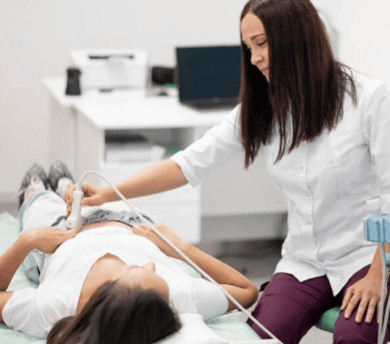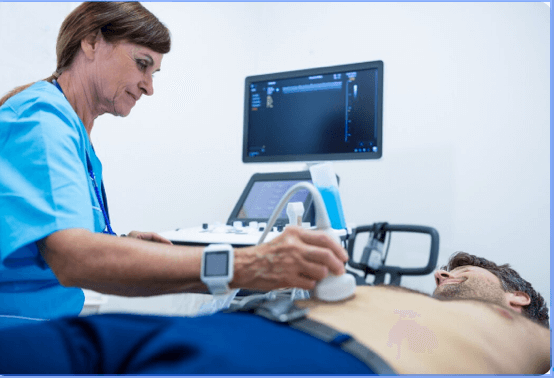
Ultrasound-guided injections have become an important skill for physicians working in pain management, sports medicine, orthopedics, physical medicine and rehabilitation, and other clinical settings.
Unlike landmark-guided procedures, ultrasound guidance allows clinicians to visualize anatomy and the needle in real time. Developing this skill, however, requires more than understanding where anatomical structures are located. Physicians also need to learn probe positioning, image optimization, needle visualization, hand-eye coordination, patient positioning, and procedural technique.
Hands-on courses provide direct practice and instructor feedback, while online programs can provide flexibility and allow physicians to review foundational material at their own pace. Some modern programs combine both approaches.
What Is Hands-On Ultrasound Injection Training?
Hands-on training is conducted in person and gives physicians an opportunity to work directly with ultrasound equipment and practice scanning or injection techniques under instructor supervision.
A live workshop may include demonstrations followed by supervised practice. Depending on the course, physicians may work with anatomical models, simulated environments, cadaver specimens, or other practical training formats.
For example, current physician ultrasound workshops offered by Mayo Clinic include practical training in diagnostic and interventional musculoskeletal ultrasound, with emphasis on ultrasound-guided injections, sonoanatomy, needle visualization, procedural accuracy, and patient safety.
The defining advantage of this format is direct interaction. Physicians can perform the techniques rather than simply watching someone else perform them.
What Are Online Ultrasound Injection Courses?
Online ultrasound education allows physicians to learn through recorded lectures, demonstrations, live virtual sessions, case presentations, quizzes, and other digital resources.
Online programs can be especially useful for physicians who cannot travel to a training center or take several days away from clinical practice.
Some programs are completely self-paced, while others combine scheduled virtual instruction with recordings and faculty support.
Online ultrasound education can provide valuable theoretical knowledge, including ultrasound physics, anatomy, image interpretation, probe selection, machine settings, procedural indications, and safety principles.
However, physicians should distinguish between learning about an injection procedure online and actually developing the psychomotor skills needed to perform it.
Hands-On vs. Online: The Biggest Difference
The biggest difference between the two formats is physical skill development.
Online education can show a physician how a probe should be positioned or how a needle appears on the ultrasound screen. A physician can pause a video, review an image, and repeat a demonstration several times. A live workshop allows the physician to physically position the probe, manipulate the equipment, identify structures, coordinate needle movement with the ultrasound image, and receive immediate feedback.
That distinction matters because ultrasound-guided procedures involve coordination between visual information and physical movement. For physicians learning these skills for the first time, direct supervised practice can be particularly valuable.
Advantages of Hands-On Training
Hands-on training provides physicians with practical experience that online education alone may not fully replicate. Through supervised practice, participants can develop confidence with ultrasound equipment, improve image acquisition and interpretation skills, and learn how to perform ultrasound-guided procedures more effectively.
Real-Time Instructor Feedback
One of the strongest advantages of hands-on live workshops is immediate feedback. An instructor can observe how a physician holds the transducer, adjusts the probe, positions the patient, manipulates the needle, and interprets the image.
If the image is poor or the needle is not being visualized appropriately, the instructor can help correct the technique at the moment the problem occurs. This type of feedback is difficult to replicate through a standard recorded online course.
Practice With Ultrasound Equipment
Hands-on programs allow physicians to become familiar with actual ultrasound systems. They can practice adjusting controls, optimizing images, changing probe orientation, and recognizing how small movements affect the displayed anatomy. These skills can feel very different when performed on actual equipment compared with watching a demonstration.
Limitations of Hands-On Training
Hands-on courses also have disadvantages. Travel may be required, and physicians may need to take time away from clinical responsibilities. Course fees can also be higher when facility, equipment, faculty, and practical training costs are included.
A live workshop is also limited by its duration. A one- or two-day course can provide intensive exposure, but physicians still need continued practice after returning to their clinical environment. A short course should therefore be viewed as part of skill development rather than an automatic guarantee of independent procedural competence.
Even established educational providers emphasize that course attendance does not itself guarantee proficiency in the procedures taught.
Advantages of Online Ultrasound Education
Online ultrasound education provides physicians with a flexible way to develop and strengthen their knowledge without the need to attend every course or training session in person. Digital courses can cover topics such as ultrasound-guided procedures, image interpretation, anatomy, equipment use, and clinical applications.
Flexible Learning
Flexibility is one of the strongest advantages of online physician education. A physician can often complete lessons around clinical responsibilities rather than traveling to a specific location on a fixed schedule. This can make online education attractive to physicians with demanding schedules or limited access to local training programs.
Review Complex Concepts Multiple Times
Online learning allows physicians to revisit material. If a physician needs additional review of ultrasound anatomy, needle visualization, image optimization, or a specific procedure, recorded lessons can often be watched again. This can be particularly useful when learning theoretical concepts before attending a practical workshop.
Convenient Continuing Education
Online programs can also work well for continuing education when a physician already has practical ultrasound experience.
An experienced clinician may not need an introductory in-person course for every new topic. Online lectures, case discussions, and demonstrations can provide an efficient way to learn new concepts.
Limitations of Online Training
The main limitation is the lack of direct physical supervision. Watching a physician perform an injection does not necessarily mean that the learner can reproduce the technique safely and accurately.
A video can demonstrate probe placement, needle approach, and image interpretation, but it cannot physically correct the learner's hand position. Online courses can therefore be excellent for knowledge acquisition while being less suitable as the sole method for developing practical injection skills.
Which Format Is Better for Experienced Physicians?
Experienced physicians may have different needs. At NRAP Academy, we recognize that a physician who already performs ultrasound-guided procedures may benefit from online education when learning a new anatomical region, reviewing evidence, or studying a specialized procedure.
However, hands-on education can still be valuable when learning technically demanding procedures or working with unfamiliar equipment.
The key question is not simply whether the physician has experience. It is whether the physician already possesses the specific practical skills required for the new technique.
The Case for Blended Learning
For many physicians, blended learning may provide the strongest overall approach. A blended program combines online education with practical training.
The physician can study anatomy, ultrasound principles, procedural indications, and demonstrations online before attending an in-person workshop. The live portion can then focus more heavily on scanning, needle guidance, troubleshooting, and supervised practice. This approach can make the most of limited classroom time.
Some ultrasound education providers already use this structure. Gulfcoast Ultrasound Institute, for example, describes blended courses that combine online learning with a scheduled hands-on scanning workshop. Other programs similarly combine online content with practical sessions or workshops.
What Should Physicians Look for in an Ultrasound Course?
The delivery format is only one factor when choosing a course. Physicians should also examine the curriculum, faculty qualifications, practical training opportunities, class size, equipment, CME accreditation where relevant, and post-course resources. A strong program should clearly explain what learners will be expected to know and perform by the end of the course.
Curriculum Depth
Look for courses that cover more than individual injection techniques. A comprehensive program may include ultrasound physics, image optimization, sonoanatomy, transducer handling, needle visualization, patient positioning, procedural indications, contraindications, complications, and safety. These fundamentals provide the foundation for performing procedures appropriately.
Amount of Practical Time
If the goal is practical skill development, the amount of hands-on time matters. A course that advertises hands-on training but provides only a brief demonstration may not provide the same learning opportunity as a program where participants spend substantial time scanning and practicing techniques. Ask how much time each participant actually spends using the equipment.
Instructor-to-Participant Ratio
Smaller groups can make it easier to receive individual feedback. If an instructor is responsible for a large group of participants, there may be limited opportunity for each physician to practice and receive personalized correction. The quality of supervision can be just as important as the number of hours advertised.
Type of Practical Model
Physicians should determine what they will actually practice on. Some courses use anatomical models or simulation. Others use live scanning, cadaver-based education, or other practical formats.
For example, some advanced courses provide cadaver-based training for ultrasound-guided injection techniques, giving physicians an opportunity to work with realistic anatomy in a controlled educational environment.
Faculty Experience
Faculty should have appropriate clinical and teaching experience in the procedures being taught. Physicians should look beyond marketing language and review the instructors' professional backgrounds, clinical specialties, and relevant experience.
What About CME Credit?
CME credit can be an important consideration, particularly for physicians who need to meet continuing education requirements. However, CME credit should not be the only reason to choose an ultrasound course.
A program offering many CME hours may not necessarily provide the practical experience needed to develop procedural skills. Physicians should consider CME accreditation alongside curriculum quality, hands-on exposure, faculty supervision, and relevance to their practice.
Can Online Training Replace Hands-On Practice?
For physicians learning ultrasound-guided injections for the first time, online education should generally not be viewed as a complete replacement for supervised practical training. Online education can explain concepts and demonstrate procedures very effectively. It can also provide a useful foundation before practical training.
A physician needs to learn how to manipulate the probe, optimize the image, maintain visualization, coordinate needle movement, recognize anatomical structures, and respond to changing visual information. These are physical and visual skills that are difficult to develop through passive video instruction alone.
Final Thoughts
Hands-on education offers direct practice, immediate instructor feedback, equipment familiarity, and the opportunity to develop probe and needle coordination. Online education offers flexibility, repeatable learning, convenient access, and an effective way to build foundational knowledge.
For many learners, however, the most practical option may be a blended approach. Online education can establish the theoretical foundation, while live workshops provide the supervised practice needed to develop procedural skills. Current ultrasound education programs increasingly use this combination, and early educational experience supports integrating online learning with simulation and hands-on training
FAQs
Is hands-on ultrasound injection training better than online training?
For physicians learning practical ultrasound-guided injection skills, hands-on training offers an important advantage because participants can practice directly and receive immediate instructor feedback. Online training is useful for foundational knowledge and review.
Can physicians learn ultrasound-guided injections online?
Online courses can teach anatomy, ultrasound principles, image interpretation, procedural concepts, and demonstrate injection techniques. However, physicians should seek appropriate supervised practical training before independently performing procedures they have not previously mastered.
Are live ultrasound workshops worth it for physicians?
They can be particularly valuable for physicians who are new to ultrasound or want to improve practical procedural skills. The value depends on the amount of hands-on practice, quality of supervision, curriculum, and relevance to the physician's clinical practice.
What is blended ultrasound education?
Blended education combines online learning with in-person practical training. Physicians can complete lectures and demonstrations remotely before attending a workshop focused on scanning and procedural practice.
How should physicians choose an ultrasound injection course?
Consider the curriculum, faculty experience, hands-on hours, instructor-to-learner ratio, equipment, practical model, CME accreditation, course format, and post-course educational support.