Intra-articular Ketorolac Injections: An Effective Alternative for Musculoskeletal Pain Management
Musculoskeletal conditions such as bursitis, adhesive capsulitis, and osteoarthritis affect millions and often require injectable therapies to reduce pain and inflammation. Traditionally, corticosteroid injections have been the mainstay treatment. However, concerns over side effects like tendon rupture, cartilage damage, and systemic hyperglycemia have prompted exploration of alternatives. A recent narrative review by Kiel et al. (2024) highlights ketorolac—a parenteral nonsteroidal anti-inflammatory drug (NSAID)—as a promising substitute for corticosteroids in musculoskeletal injections.
Warning: OFF Label use of Ketorolac discussed. Please consult your physician.
See full article for details.
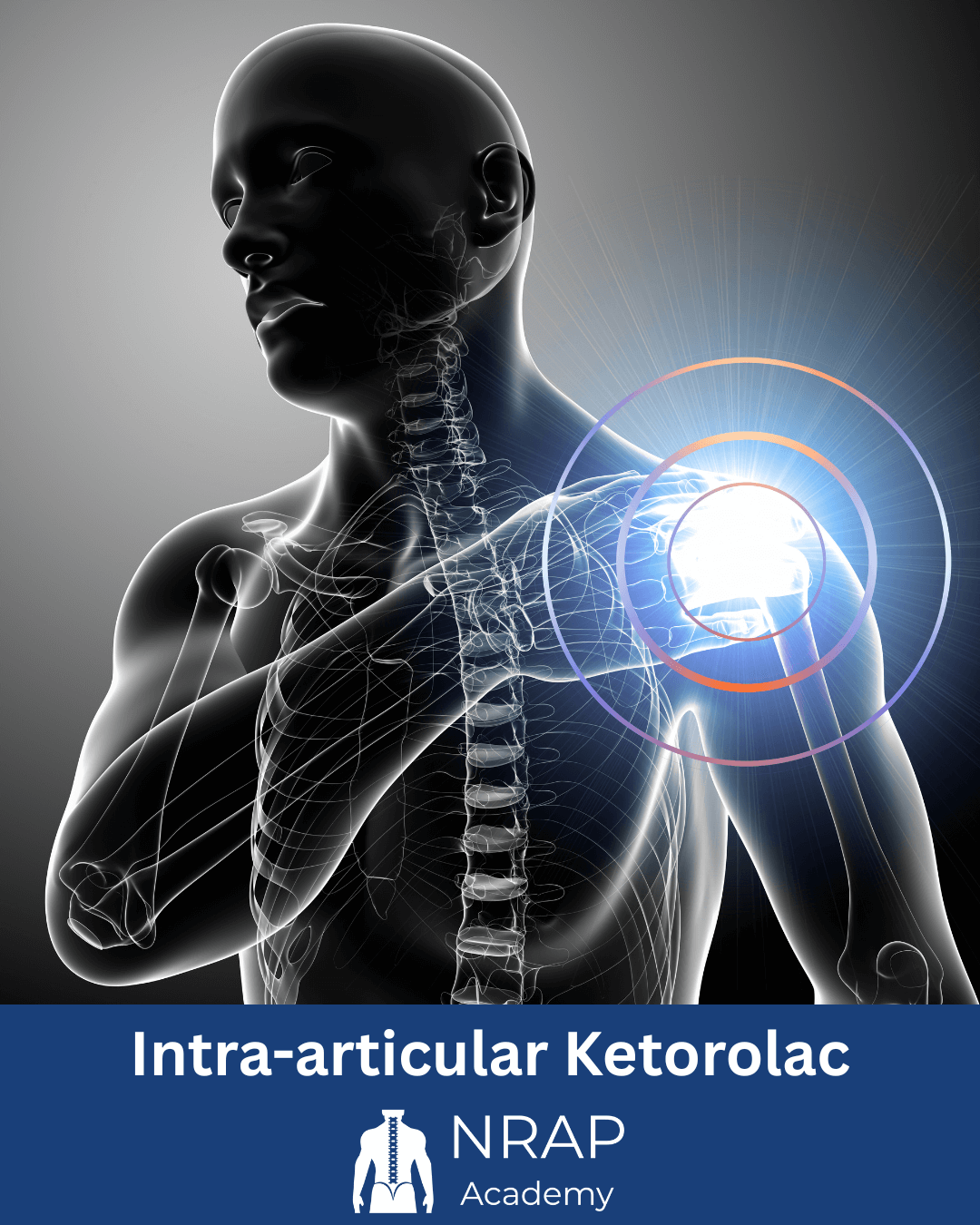 Subacromial Ketorolac Injections for Shoulder Pain
Subacromial bursitis and impingement syndrome are common causes of shoulder pain and disability. Several randomized controlled trials have shown that subacromial ketorolac injections provide pain relief and functional improvement comparable to corticosteroids:
- Goyal et al. demonstrated significant reductions in pain scores after subacromial injection of 60 mg ketorolac versus 40 mg methylprednisolone, with no difference in outcomes between groups.
- Taheri et al. found similar short-term pain relief at 1 and 3 months with either ketorolac or corticosteroid subacromial injections.
- Kim et al. reported equivalent clinical improvement in rotator cuff syndrome patients receiving ketorolac or triamcinolone injections.
- Min et al. noted ketorolac led to better forward flexion and patient satisfaction at 4 weeks compared to corticosteroids.
These studies support ketorolac as an effective agent for subacromial injection, offering an alternative for patients where corticosteroid use is limited.
Intra-articular Ketorolac Injections for Adhesive Capsulitis and Osteoarthritis
Adhesive capsulitis (frozen shoulder) and osteoarthritis of the hip, knee, and carpometacarpal joint are often treated with intra-articular corticosteroids. Ketorolac injections have shown comparable efficacy in these conditions:
- Akhtar et al. found intra-articular ketorolac significantly reduced shoulder pain at 4 weeks in adhesive capsulitis compared to hyaluronic acid.
- Ahn et al. reported similar pain relief between intra-articular ketorolac and corticosteroid injections in adhesive capsulitis, with ketorolac providing superior shoulder mobility at 3 and 6 months.
- Koh et al. showed that adding ketorolac to hyaluronic acid injections in carpometacarpal osteoarthritis resulted in faster onset of pain relief compared to hyaluronic acid alone.
- Park et al. observed equivalent functional improvements with intra-articular ketorolac or corticosteroids in hip osteoarthritis.
- Jurgensmeier et al. demonstrated similar symptom improvement at 1 and 3 months post-injection for ketorolac and triamcinolone in hip and knee osteoarthritis.
- Xu et al. and Bellamy et al. confirmed ketorolac’s comparable pain relief and functional benefits to corticosteroids for knee osteoarthritis, with ketorolac being more cost-effective.
- Lee et al. noted quicker pain reduction with intra-articular ketorolac combined with hyaluronic acid versus hyaluronic acid alone in knee osteoarthritis.
 Safety and Pharmacologic Considerations- Intra-articular Ketorolac
Ketorolac’s anti-inflammatory action stems from cyclooxygenase inhibition, reducing prostaglandin synthesis. Its half-life is approximately 5.2–5.6 hours, and it is metabolized in the liver. Unlike corticosteroids, ketorolac avoids systemic hyperglycemia and cartilage damage risks. Animal and in vitro studies suggest ketorolac may protect cartilage by inhibiting inflammatory cytokines.
While gastrointestinal, renal, and cardiovascular risks associated with NSAIDs remain considerations, localized intra-articular and subacromial ketorolac injections may limit systemic exposure and adverse effects. Mild, transient post-injection pain has been reported but resolves without intervention.
Conclusion
Ketorolac injections, administered intra-articularly or subacromially, are a safe, effective, and economical alternative to corticosteroids for managing common musculoskeletal conditions. Their comparable efficacy in reducing pain and improving function, combined with a more favorable side effect profile, makes ketorolac an appealing option for clinicians and patients alike. Further research is warranted to fully elucidate long-term safety and optimal dosing strategies.
FAQS on Intra-articular Ketorolac Injections
Ketorolac Injections for Musculoskeletal Conditions: Frequently Asked Questions
Musculoskeletal pain from conditions like bursitis, adhesive capsulitis, and osteoarthritis often requires injectable treatments. Ketorolac, a nonsteroidal anti-inflammatory drug (NSAID), is emerging as a promising alternative to corticosteroids. Below are common questions and answers based on a recent narrative review by Kiel et al. (2024).
1. What is ketorolac and how does it work?
Ketorolac is a parenteral NSAID that reduces pain and inflammation by inhibiting cyclooxygenase enzymes, which decreases prostaglandin synthesis. It can be administered orally, intramuscularly, intravenously, or by injection directly into joints or around bursae.
2. How effective is ketorolac for musculoskeletal conditions?
Studies show ketorolac injections provide significant pain relief and functional improvement comparable to corticosteroids in conditions like:
- Subacromial bursitis and shoulder impingement (subacromial injections)
- Adhesive capsulitis (frozen shoulder) (intra-articular injections)
- Osteoarthritis of the hip, knee, and thumb carpometacarpal joint (intra-articular injections)
3. What evidence supports subacromial ketorolac injections?
Randomized controlled trials found:
- Goyal et al. and Taheri et al. reported similar pain reduction and functional outcomes between ketorolac and corticosteroids for subacromial injections.
- Kim et al. and Min et al. observed comparable or better patient satisfaction and shoulder mobility with ketorolac versus corticosteroids.
4. How does intra-articular ketorolac compare to corticosteroids for adhesive capsulitis?
- Akhtar et al. showed ketorolac reduced shoulder pain more than hyaluronic acid.
- Ahn et al. found ketorolac and corticosteroids equally effective for pain relief, with ketorolac providing better shoulder mobility at 3 and 6 months.
5. What about Intra-articular Ketorolac for osteoarthritis?
- Ketorolac combined with hyaluronic acid provided faster pain relief than hyaluronic acid alone in thumb carpometacarpal joint osteoarthritis (Koh et al.).
- Intra-articular ketorolac had similar efficacy to corticosteroids in hip (Park et al., Jurgensmeier et al.) and knee osteoarthritis (Bellamy et al., Xu et al.).
- Ketorolac injections were more cost-effective compared to corticosteroids (Bellamy et al.).
6. Are Intra-articular Ketorolac injections safe?
Ketorolac's side effects are similar to other NSAIDs, mainly involving gastrointestinal, renal, and cardiovascular risks. However, localized intra-articular and subacromial injections may reduce systemic exposure. Animal studies suggest ketorolac does not harm cartilage and may protect against inflammatory damage. Mild, transient local pain post-injection is possible but usually resolves without treatment.
7. What are the limitations of ketorolac use?
Ketorolac is not suitable for patients with:
- Renal impairment
- Gastrointestinal ulcers or bleeding risk
- Cardiovascular disease or hypertension
- NSAID hypersensitivity, especially in asthma or chronic urticaria patients
Clinicians should assess individual risks before choosing ketorolac injections.
8. How does ketorolac’s pharmacokinetics affect its use?
Ketorolac has a plasma half-life of about 5.2 to 5.6 hours and is metabolized in the liver. Pharmacokinetics for subcutaneous or intra-articular administration are less defined but systemic absorption occurs. Its relatively short half-life supports repeated dosing if needed.
9. Why consider Intra-articular Ketorolac over corticosteroids?
Ketorolac avoids corticosteroid-associated risks such as tendon rupture, cartilage damage, and steroid-induced hyperglycemia. It is also more cost-effective, making it a favorable option for patients and healthcare systems.
10. What further research is needed for Intra-articular Ketorolac ?
More large-scale, long-term studies are needed to fully understand ketorolac’s intra-articular effects, optimal dosing, and safety profile compared to corticosteroids and other treatments.
Summary:
Ketorolac injections, whether intra-articular or subacromial, offer a safe, effective, and economical alternative to corticosteroids for managing various musculoskeletal conditions. This makes ketorolac an important option in pain management and inflammation control.
Reference:
Kiel J, Applewhite AI, Bertasi TGO, Bertasi RAO, Seemann LL, Costa LMC, Helmi H, Pujalte GGA. Ketorolac Injections for Musculoskeletal Conditions: A Narrative Review. Clinical Medicine & Research. 2024;22(1):19-27. DOI: https://doi.org/10.3121/cmr.2024.1847
Dr. Rosenblum's Biography

David Rosenblum, MD, currently serves as the Director of Pain Management at Maimonides Medical Center and AABP Integrative Pain Care. As a member of the Department of Anesthesiology, he is involved in teaching, research, CME activities, and was key faculty in developing the anesthesiology residency's regional anesthesia block rotation, as well as institutional wide acute and chronic pain management protocols to ensure safe and effective pain management. He currently is a managing partner in a multi-physician private pain practice, AABP Integrative Pain Care, located in Brooklyn, NY. He is one of the earliest interventional pain physicians to integrate ultrasound guidance to improve the safety and accuracy of interventional pain procedures.
Awards
New York Magazine: Top Doctors: 2016, 2017, 2018, 2021, 2022, 2023, 2024, 2025
Schneps Media: 2015, 2016, 2017, 2019, 2020
Top Doctors New York Metro Area (digital guide): 2016, 2017, 2018, 2019, 2020, 2021, 2022, 2023 2025
Schneps Media - Brooklyn Courier Life: 2021, 2022, 2023
Dr. Rosenblum written several book chapters on Peripheral Neuromodulation, Radiofrequency Ablation, and Pharmacology. He has published numerous noteworthy articles and most recently is developing the ASIPP Guidelines for Peripheral Neuromodulation in the treatment of chronic pain. He has been named several times in NY Magazine's Best Pain Management Doctor List, Nassau County’s Best Pain Physician, has appeared on NY1 News, and has made several appearances on XM Radio's Doctor Talk. He currently is lecturing on a national and international level and has partnered with the American Society of Interventional Pain Physicians (ASIPP), American Society of Pain and Neuroscience (ASPN), IASP Mexican Chapter, Eastern Pain Association (EPA), the North American Neuromodulation Society (NANS), World Academy of Pain Medicine United, as well as various other organizations, to support educational events and develop new courses. Since 2008, he has helped over 3000 physicians pass the Pain Management Boards, and has been at the forefront of utilizing ultrasound guidance to perform pain procedures. He now hosts the PainExam podcast, AnesthesiaExam Podcast, PMRExam Podcasts and uses this platform to promote the safe and effective use of ultrasound in the performance of various procedures such as Peripheral Nerve Stimulation, Caudal Epidurals, Selective Nerve Root Blocks, Cluneal Nerve Blocks, Ganglion impar Blocks, Stellate Ganglion Blocks, Brachial Plexus Blocks, Joint Injections and much more!
Doctor Rosenblum created the NRAP (Neuromodulation Regional Anesthesia and Pain) Academy and travels to teach various courses focused on Pain Medicine, Regenerative Medicine, Ultrasound Guided Pain Procedures and Regional Anesthesia Techniques.
Dr. Rosenblum is persistent when it comes to eliminating pain and has gained a reputation among his patients for thinking "outside the box" and implements ultrasound guidance to deposit medications, biologics (PRP, Bone Marrow Aspirate, etc.) and Peripheral Nerve Stimulators near pain generators.
He is currently treating patients in his great neck and Brooklyn office. For an appointment go to AABPpain.com or call
Brooklyn 718 436 7246
Disclaimer: This Podcast, website and any content from NRAP Academy (PMRexam.com) otherwise known as Qbazaar.com, LLC is for general informational purposes only and does not constitute the practice of medicine, nursing or other professional health care services, including the giving of medical advice, and no doctor/patient relationship is formed. The use of information on this podcast or materials linked from this podcast is at the user’s own risk. Professionals should conduct their own fact finding, research, and due diligence to come to their own conclusions for treating patients. The content of this podcast is not intended to be a substitute for professional medical advice, diagnosis, or treatment. Users should not disregard or delay in obtaining medical advice for any medical condition they may have and should seek the assistance of their health care professionals for any such conditions.