Ultrasound-Guided Nerve Blocks: What Pain Physicians Need to Know
Ultrasound-guided nerve blocks have become a core competency for pain physicians — both for board exams and for day-to-day procedural accuracy. Whether you're prepping for the ABA Pain Medicine exam or looking to sharpen your technique in clinic, mastering ultrasound-guided nerve blocks pays dividends in both settings. In this post, we break down the anatomy, step-by-step technique, and exam relevance of one commonly tested approach: the ultrasound-guided intercostal nerve block.
Table of Contents
- Watch: Ultrasound-Guided Intercostal Nerve Block
- Relevant Anatomy for Ultrasound-Guided Nerve Blocks
- Step-by-Step Technique
- Landmark-Based vs. Ultrasound-Guided Nerve Blocks
- Why This Matters for the ABA Pain Medicine Boards
- Keep Learning: Podcast & More Videos
- Get Board-Ready & Hands-On Training
- Looking for a Pain Specialist?
- Frequently Asked Questions
- About David Rosenblum, MD
Watch: Ultrasound-Guided Intercostal Nerve Block for Post-Mastectomy Pain Syndrome
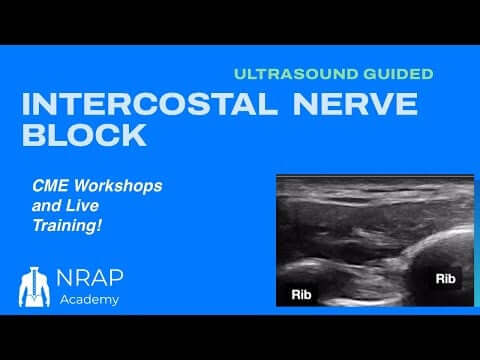
In this video, we walk through probe placement, target identification, and injectate spread for an ultrasound-guided intercostal nerve block — a technique that shows up both in exam vignettes and in real-world post-mastectomy pain management.
Relevant Anatomy for Ultrasound-Guided Nerve Blocks
Performing safe and effective ultrasound-guided nerve blocks in the thoracic region starts with a solid mental map of the intercostal space. Each intercostal nerve runs beneath its corresponding rib within the costal groove, accompanied by the intercostal vein and artery — remembered by the mnemonic VAN, ordered superior to inferior. On ultrasound, the rib appears as a hyperechoic curvilinear structure with posterior acoustic shadowing, while the pleura is seen as a bright, sliding hyperechoic line just deep to the internal intercostal muscle. Correctly identifying this pleural line is the single most important safety checkpoint before advancing any needle, since it defines the deep limit of a safe injection.
Step-by-Step Technique
A typical approach to ultrasound-guided nerve blocks in this region follows a consistent sequence:
- Position and prep: Patient prone or lateral decubitus, target rib level marked and prepped sterilely.
- Probe selection and orientation: A high-frequency linear probe is placed parasagittally over the target rib, then walked caudally into the intercostal space until the pleural line comes into view.
- Needle insertion: An in-plane approach allows continuous needle-tip visualization as it advances toward the inferior rib margin, avoiding the neurovascular bundle where possible.
- Confirm and inject: After negative aspiration, a small test dose is injected to confirm spread along the fascial plane without intravascular or intrapleural uptake, followed by the remaining volume.
- Reassess: A brief post-procedure ultrasound sweep helps rule out pneumothorax before the patient is repositioned.
| Skill | Why It's Tested | Where to Practice |
|---|---|---|
| Sonoanatomy recognition | Image-based exam questions | PainExam question bank |
| Needle trajectory planning | Procedural safety scenarios | Ultrasound Training workshops |
| Injectate spread interpretation | Efficacy/complication questions | Live preceptorship |
Landmark-Based vs. Ultrasound-Guided Nerve Blocks
Before ultrasound became standard, intercostal blocks were performed by palpating the rib and "walking off" the inferior border by feel alone — a technique that still works, but carries a higher blind-puncture risk to the pleura and neurovascular bundle. Ultrasound-guided nerve blocks let the physician directly visualize the pleural line, confirm needle-tip position in real time, and watch local anesthetic spread as it happens, which is why direct visualization has become the preferred standard both clinically and on modern board exams. For pain physicians building procedural confidence, the shift from landmark technique to ultrasound-guided nerve blocks mirrors a broader trend across regional anesthesia and interventional pain medicine.
Why This Matters for the ABA Pain Medicine Boards
Ultrasound-guided nerve blocks are increasingly represented on the ABA Pain Medicine exam, particularly questions testing sonoanatomy recognition and needle trajectory planning. Comfort with these images under exam conditions comes from repetition — both hands-on and through review of high-yield question banks that include labeled ultrasound stills and short-loop clips.
Keep Learning
- 🎧 Listen: The PainExam Podcast — CMS and Peripheral Nerve Block
- 📺 More videos: NRAP Academy on YouTube
Get Board-Ready & Hands-On Training
Our PainExam Board Review Course includes high-yield questions on regional anesthesia and ultrasound-guided nerve blocks — everything you need heading into the September 2026 ABA Pain Medicine exam.
Want hands-on practice? Explore our Ultrasound Training programs, including live workshops and preceptorships where you'll perform ultrasound-guided nerve blocks under direct supervision.
Looking for a Pain Specialist?
If you or someone you know is dealing with chronic pain and looking for an experienced, board-certified pain physician who performs ultrasound-guided nerve blocks, visit RosenblumPain.com to learn more about Dr. David Rosenblum and schedule a consultation.
Frequently Asked Questions
What is an ultrasound-guided intercostal nerve block used for?
It's used to manage pain along the chest wall and ribs, commonly for post-mastectomy pain syndrome, rib fractures, and post-thoracotomy pain, by targeting the intercostal nerves under real-time ultrasound visualization.
Is ultrasound guidance tested on the ABA Pain Medicine exam?
Yes. The exam increasingly includes image-based questions on sonoanatomy and technique for ultrasound-guided nerve blocks, making hands-on familiarity valuable for both exam performance and clinical practice.
How can I get hands-on ultrasound training as a pain physician?
NRAP Academy offers live ultrasound training workshops and preceptorships alongside its board review courses — see the Ultrasound Training page for upcoming dates.
How do I find a pain management specialist in NYC?
Dr. David Rosenblum, a dual board-certified anesthesiologist and pain medicine specialist practicing in Brooklyn, NY, sees patients for chronic pain evaluation and treatment — visit RosenblumPain.com to schedule a consultation.
About David Rosenblum, MD
David Rosenblum, MD is a dual board-certified anesthesiologist and pain medicine specialist, and Director of Pain Medicine at Maimonides Medical Center in Brooklyn, NY. He is also Co-Owner and Clinic Director at AABP Integrative Pain Care and Wellness. Dr. Rosenblum earned his medical degree from the Sackler School of Medicine at Tel Aviv University, completed his internal medicine internship and residency at St. Luke's-Roosevelt Hospital (now Mount Sinai West) in Manhattan, and completed three years of anesthesia fellowship training at NYU.
An active medical educator, Dr. Rosenblum founded NRAP Academy, which provides CME-accredited board review and ultrasound training courses — including training in ultrasound-guided nerve blocks — for pain physicians worldwide, and hosts three podcasts: The PainExam, AnesthesiaExam, and PMRExam. He has authored numerous peer-reviewed publications and textbook chapters on regenerative medicine, peripheral nerve stimulation, and ultrasound-guided nerve blocks, including recent work in the International Journal of Molecular Sciences, Pain Physician, and Current Pain and Headache Reports.
Dr. Rosenblum has been recognized as a New York Magazine Top Doctor (2016–2024) and Nassau County's Best Pain Management Physician (2023), and has been featured on NY1 News and SiriusXM Radio's Doctor Talk.
NYC-area patients: schedule a consultation with Dr. Rosenblum.
Seeking an expert medical opinion or case consultation? Physicians, attorneys, and organizations outside New York — including international inquiries — are welcome to contact Dr. Rosenblum's office to discuss expert consultation.